Magnetic Solid-State Power Bank
TITANSHIELD Air
Power, never fire. Safety, light as air.
6 mm, 113 g, 5,000 mAh semi-solid-state Li-ion battery.
The thin, light pick, at a glance.

Semi-solid-state cell - SGS tested
No fire even with a steel pin through it - all five tests passed

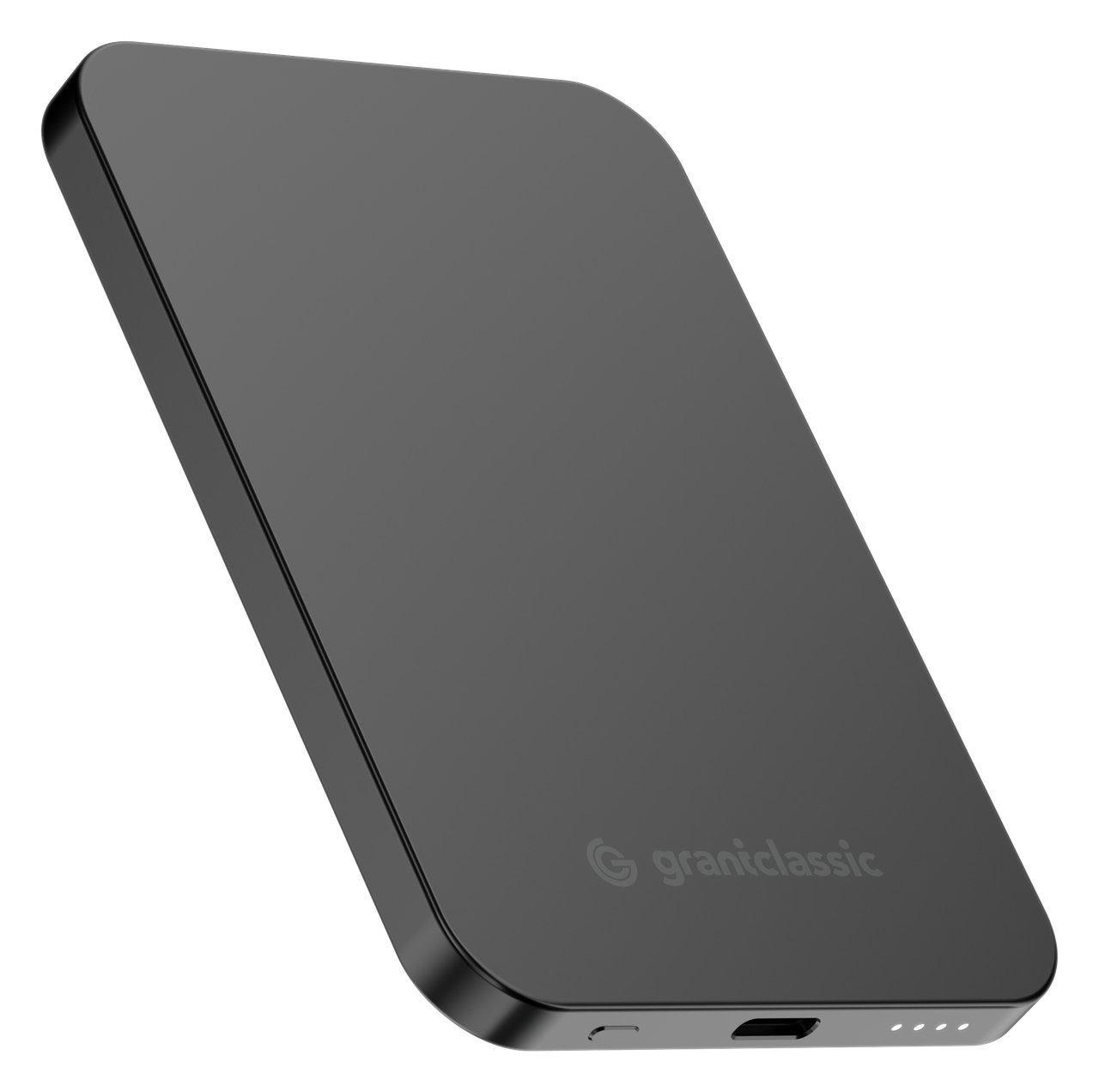
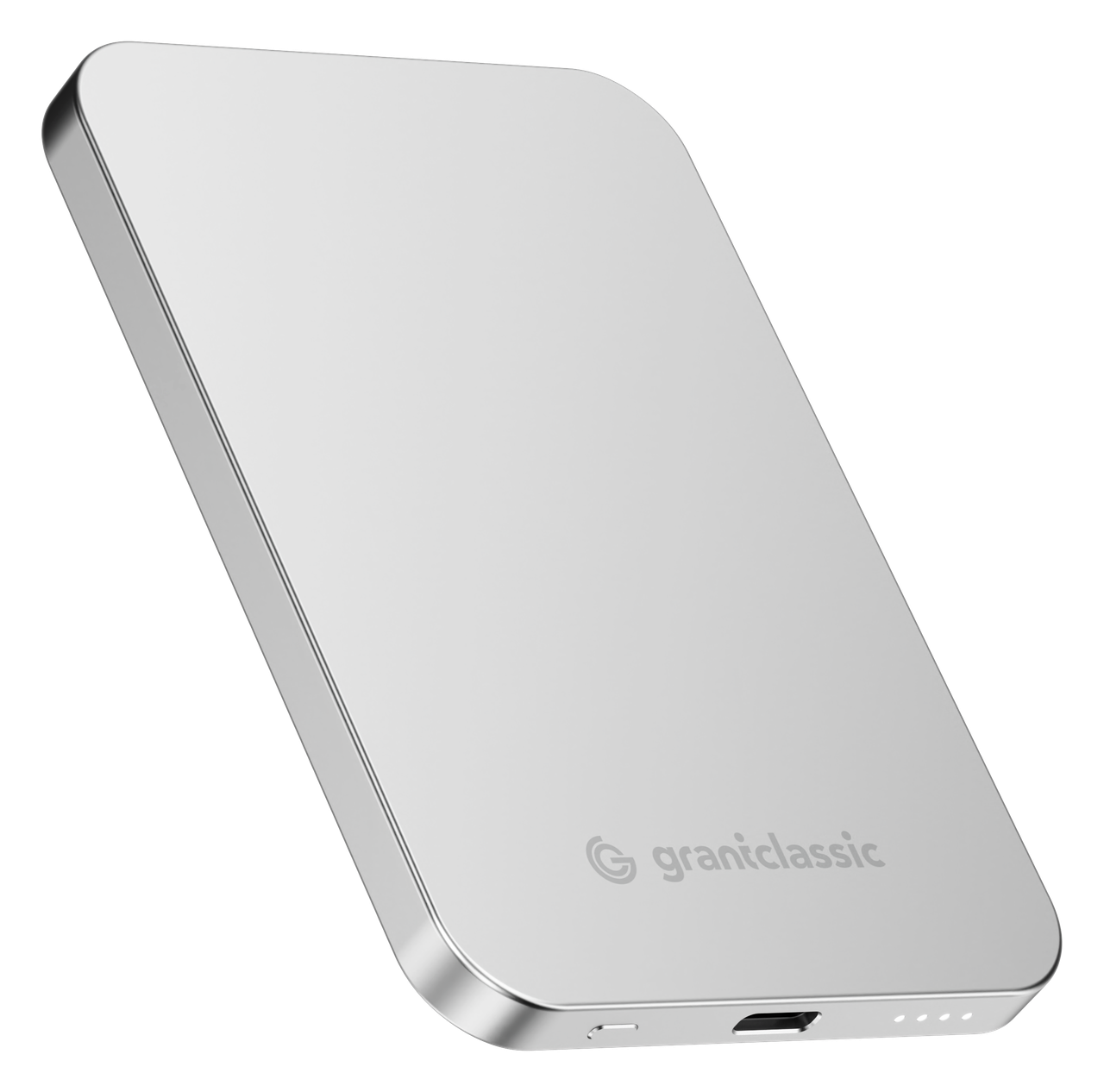
Milled from a single block of aluminum
Still flat in a shirt pocket

About the weight of a lemon
Carry one more and your shoulder won't notice

Magnetic wireless charging
Snap it on, charge while you use it

Six-way protection + NTC temperature control
One chip watching the whole time

All-day peace of mind
19.25 Wh, within carry-on limits
Puncture it.
Then measure the temperature.
The puncture test is the most direct of the cell safety tests -- a steel nail is driven through the cell body to see if it goes into runaway. The cell used in TITANSHIELD Air was sent for this test.
Voltage 4.458 V before the test, 0 V after.
Peak temperature 44.0 °C, and no runaway: no fire, no explosion.
Test conditions: 4.0 mm steel nail, 32-degree cone, 40 mm/s penetration speed, 100% penetration through the center of the largest face, ambient 77 ± 4°F (25 ± 2°C). Conducted by the SGS Taiwan reliability laboratory; report HE50024/2026 issued June 10, 2026. The sample was the cell used in this product (model 486578). The test was performed by trained staff in a laboratory. Do not attempt it yourself.
A semi-solid-state power bank -
why does puncturing it do nothing?
Because the layer separating the electrodes is semi-solid-state.
After a steel pin pierces the semi-solid-state electrolyte, it keeps its original structure - it doesn't flow, and it doesn't bridge the electrodes. So in the puncture test, the response only rises to 44.0°C, then stops there.
Most power banks use a liquid electrolyte. Once the separator is punctured or torn, the liquid leaks out and the electrodes make direct contact - the heat from the short circuit pushes the reaction further, which is thermal runaway, the fire and explosion you see in the news.
Not just puncture.
Five tests, zero fires.
Cell safety testing by SGS Taiwan -- pushing the battery to its limits to see if it fails. Every figure below is raw data from the report.
Puncture
A 4.0 mm steel nail with a 32-degree cone drives all the way through the cell at 40 mm per second.
44.0°C
No fire, no explosion
Thermal abuse
Fully charged, then heated in a chamber at 5°C per minute up to 130°C and held there for 60 minutes.
130°C / 60 min
No fire, no explosion
Overcharge
Charged at 5A without stopping, all the way to 4.7V and past the one-hour mark.
32.0°C
No fire, no explosion
Over-discharge
Discharged at 5A for 1.5 hours straight, until the cell is drained.
58.4°C
No fire, no explosion
External short
The terminals are shorted directly through a 15.14 mOhm external resistance.The cell's own tab fuses and opens the circuit.
23.4°C
No fire, no explosion
Conducted by the SGS Taiwan reliability laboratory. Reports HE40037/2026 (May 8, 2026, covering overcharge, over-discharge, external short and thermal abuse) and HE50024/2026 (June 10, 2026, puncture). The sample was the cell used in this product, model 486578. Each figure is the peak surface temperature recorded in the report and represents the tested sample only.
Thin, but
nothing cut short.
Seven layers stacked into a 6 mm body -- from the aluminum shell to the reinforced glass panel, each with its own place. Scroll down to see them one by one.
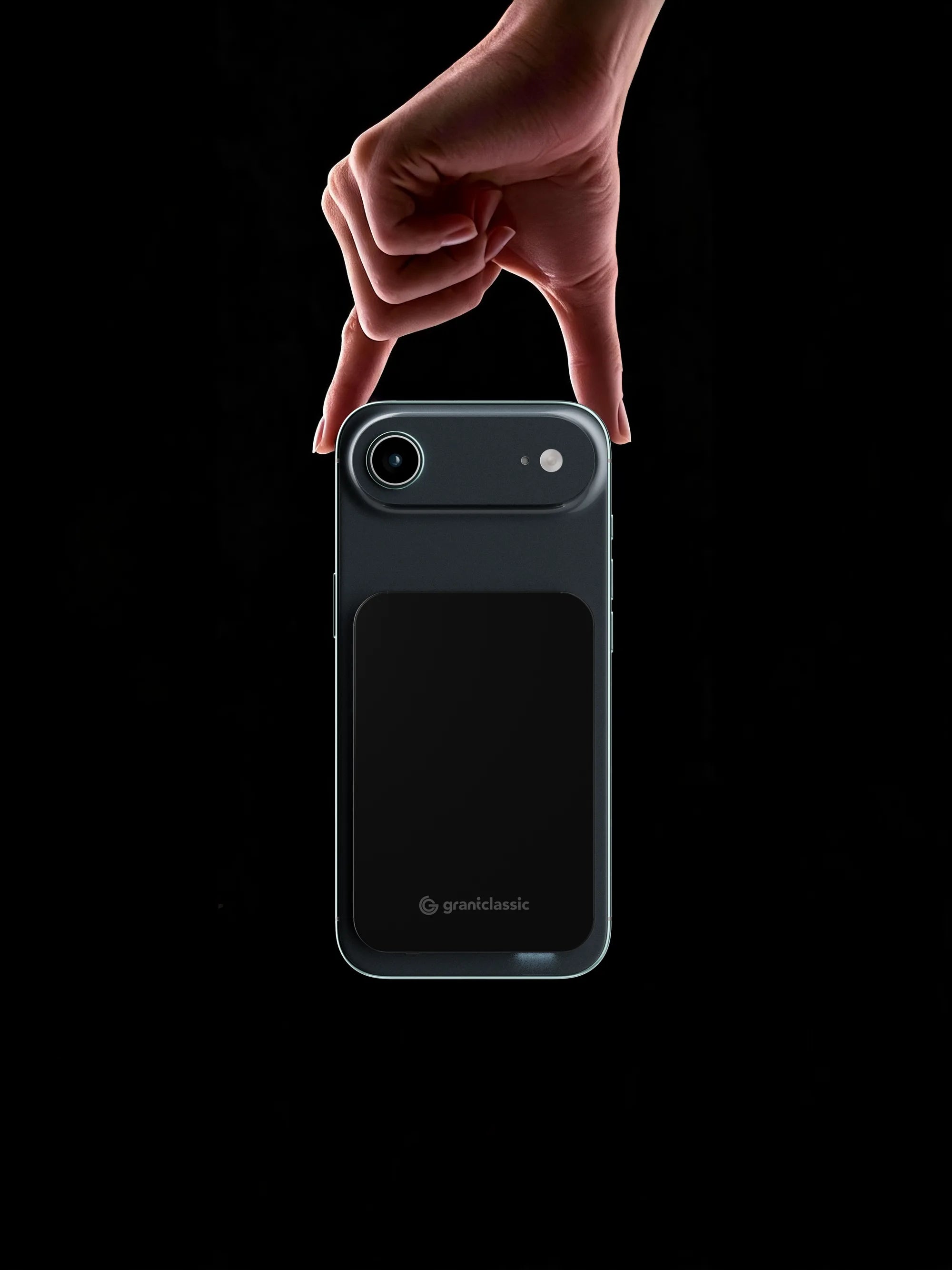
Snaps on.
Stays on.
N52 magnet ring. Holds tight, even upside down.
6 mm.
Still lies flat in a shirt pocket.
103.3 x 69.0 x 6 mm. The three bars below are drawn to actual scale in millimeters.


113 g.
Light enough to forget it's there.
About the weight of a lemon, much lighter than a phone. Carry one extra and your shoulder won't notice.
Aluminum body.
It doubles as a heat sink.
The shell is more than a shell. Heat from the cell during charging spreads across the whole aluminum body; a plastic shell can't do that, so heat just gets trapped inside.
Aluminum
150-170W/m·K
Heat spreads from the center across the whole body, so it feels evenly warm.
ABS / PC plastic
0.2-0.3W/m·K
Heat cannot escape. It pools around the cell and one small patch runs hot.
The figures are the usual thermal conductivity ranges for aluminum and ABS / PC plastic, a difference of roughly 600 times or more. Both illustrations and the curves above show the principle only; they are not measured thermal images.
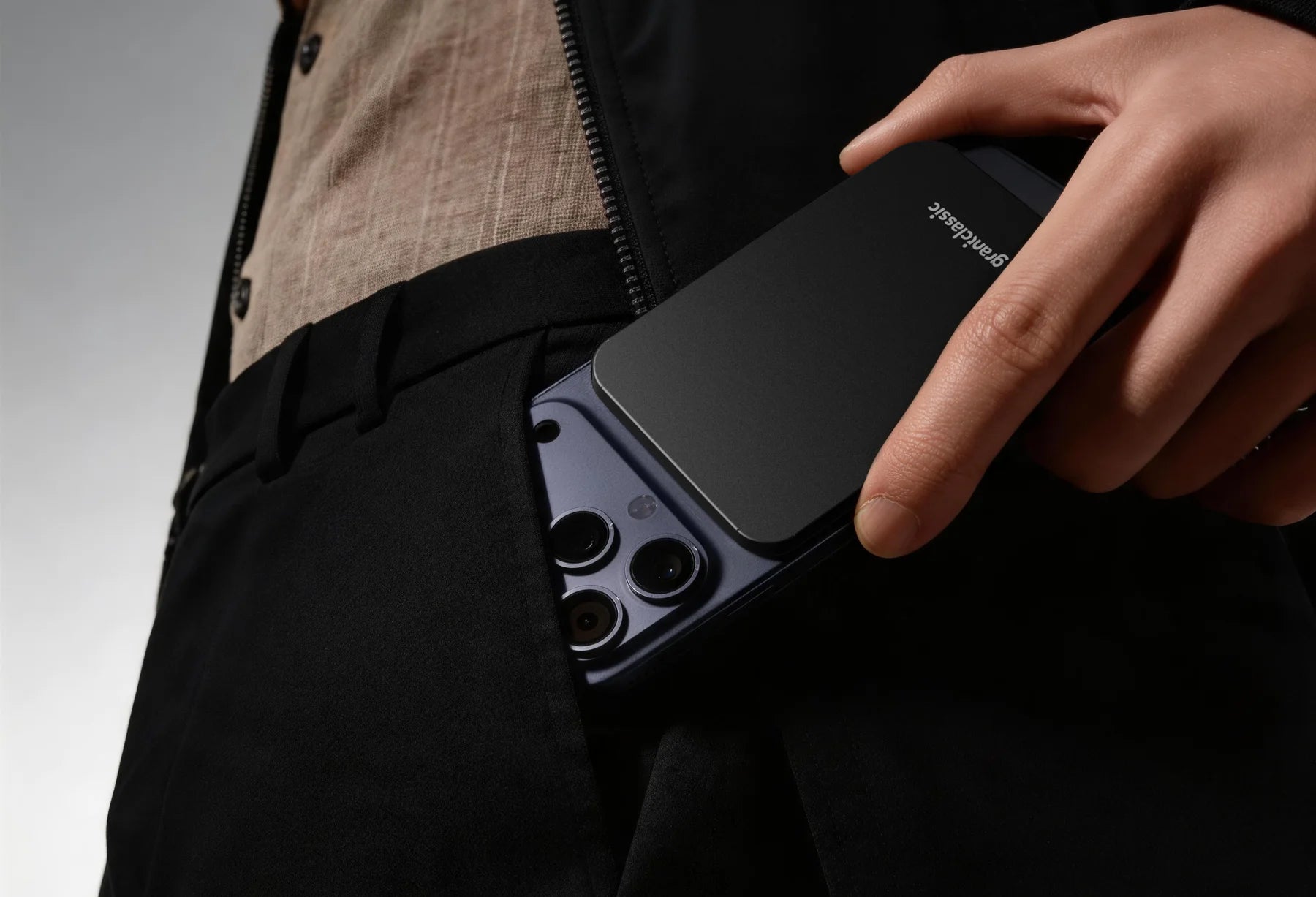
So light,
you forget it.
Drop it in a pocket and go. All day, you never feel the extra weight.
Set it down
and charging starts.
Align it with the magnetic charging zone and it starts automatically. Cabled works too -- 15W magnetic wireless or 18W wired Type-C, both from the same body.
Magnetic wireless
Type-C wired

Magnetic wireless charging, AirPods included
15W wireless. Twice the old 7.5W standard.
In the same stretch of time, twice as much energy goes in. While many wireless pads are still at 7.5W, this one has already finished.
The curves illustrate the principle: double the power, and roughly double the energy goes in over the same time. Real charging times vary with the device, the remaining charge and the ambient temperature.
Phone on top.
Earbuds on the side.
The phone charges magnetically on top while a Type-C cable charges your AirPods or watch case. One power bank covers two devices, so there is no second one to carry.
With both outputs running, each side gets half the power. For low-draw devices like earbuds, double-press the power button to enter low-current mode so they are not mistaken for fully charged and cut off.

5,000 mAh.
Enough for about one full phone charge.
Every phone's battery is a different size, so the charge it gets differs too. Below are the results for iPhone, Samsung and Google flagships.
These are rough estimates. How much you can actually recharge varies with the device, its remaining charge and how it is used.
Holds on,
won't let go.
N52 magnets, meeting the same 1.5 kg standard as Apple MagSafe. It locks on, it doesn't just sit there -- it won't slip during a walk, in your pocket, or a one-handed swipe.
We took the body down to 6 mm and kept the magnetic hold at 1.5 kg. Thin does not have to cost you grip.
0.0kg
Magnetic hold, on par with Apple MagSafe.
At 6 mm thin, that number never gave way.
Six-layer protection,
one chip watching the whole time.
Every second of charging and discharging, the protection chip watches voltage, current and temperature - and steps in the instant something goes wrong, before you'd ever notice.
- Overvoltage protection
- The moment voltage crosses the threshold, output is cut.
- Overheat protection
- At 45°C it throttles and keeps charging, then returns to full power once it cools.
- Overload protection
- If output climbs abnormally, it locks at the ceiling and limits current.
- Overcharge protection
- Full means full. No force-feeding, no trickle abuse of the cell.
- Short-circuit protection
- A short-circuit surge opens the circuit instantly and saves the cell.
- FOD foreign-object detection
- Put a key or a coin on the charging area and output stops at once.

Precise NTC temperature control
An NTC temperature sensor inside the body monitors the cell in real time. At 45°C, it doesn't cut power outright - it throttles and keeps charging, so it stays cool to the touch without stopping.
The 45°C throttle threshold comes from the product manual; the six protections' trigger points and curves are illustrative - actual behavior depends on the product firmware.
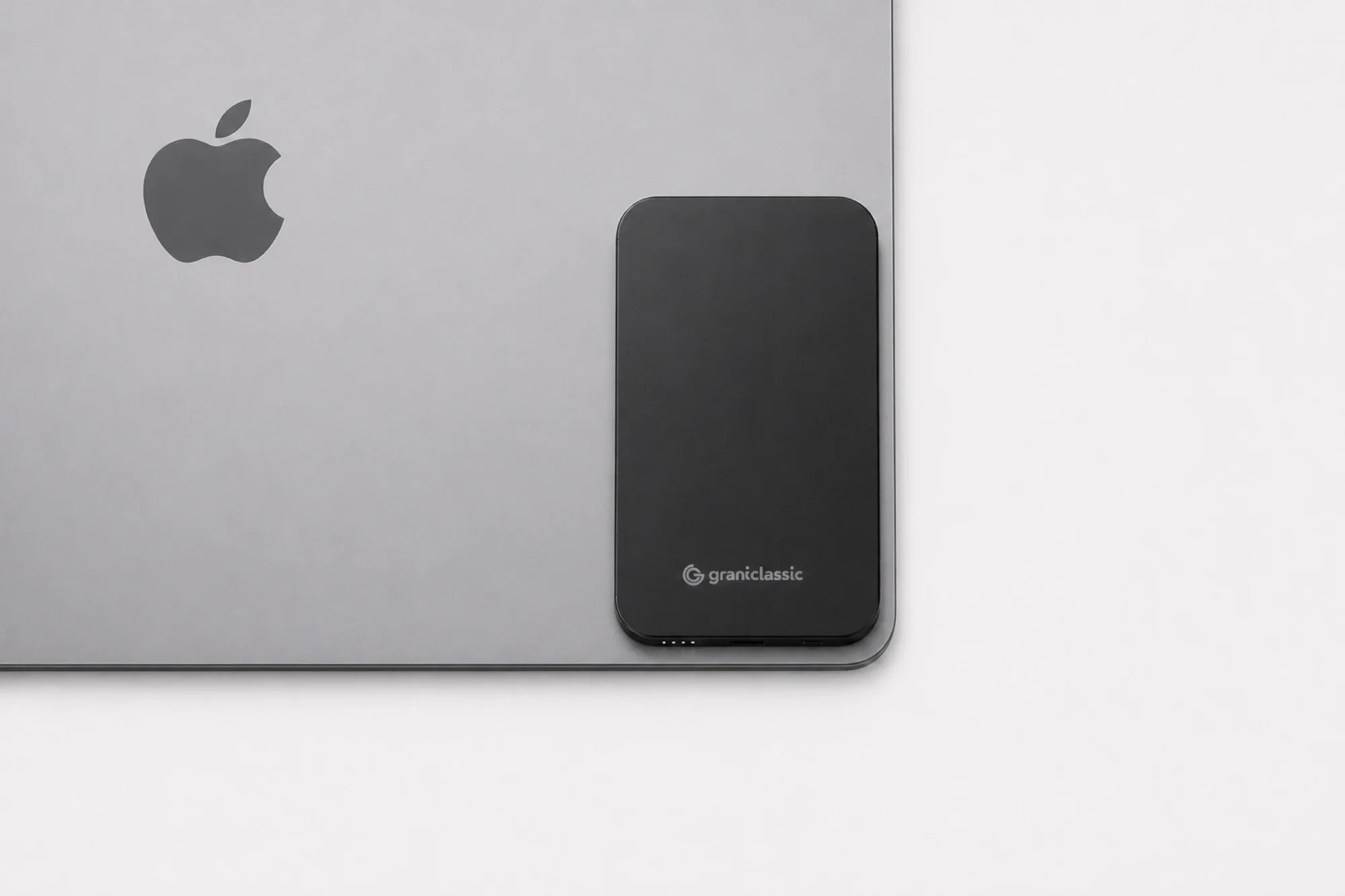
Corner radius, matched without a seam.
CNC-machined from a single block of aluminum, with a corner radius that sits flush - stacked with a MacBook, it looks like a native accessory. Apple fans will notice.
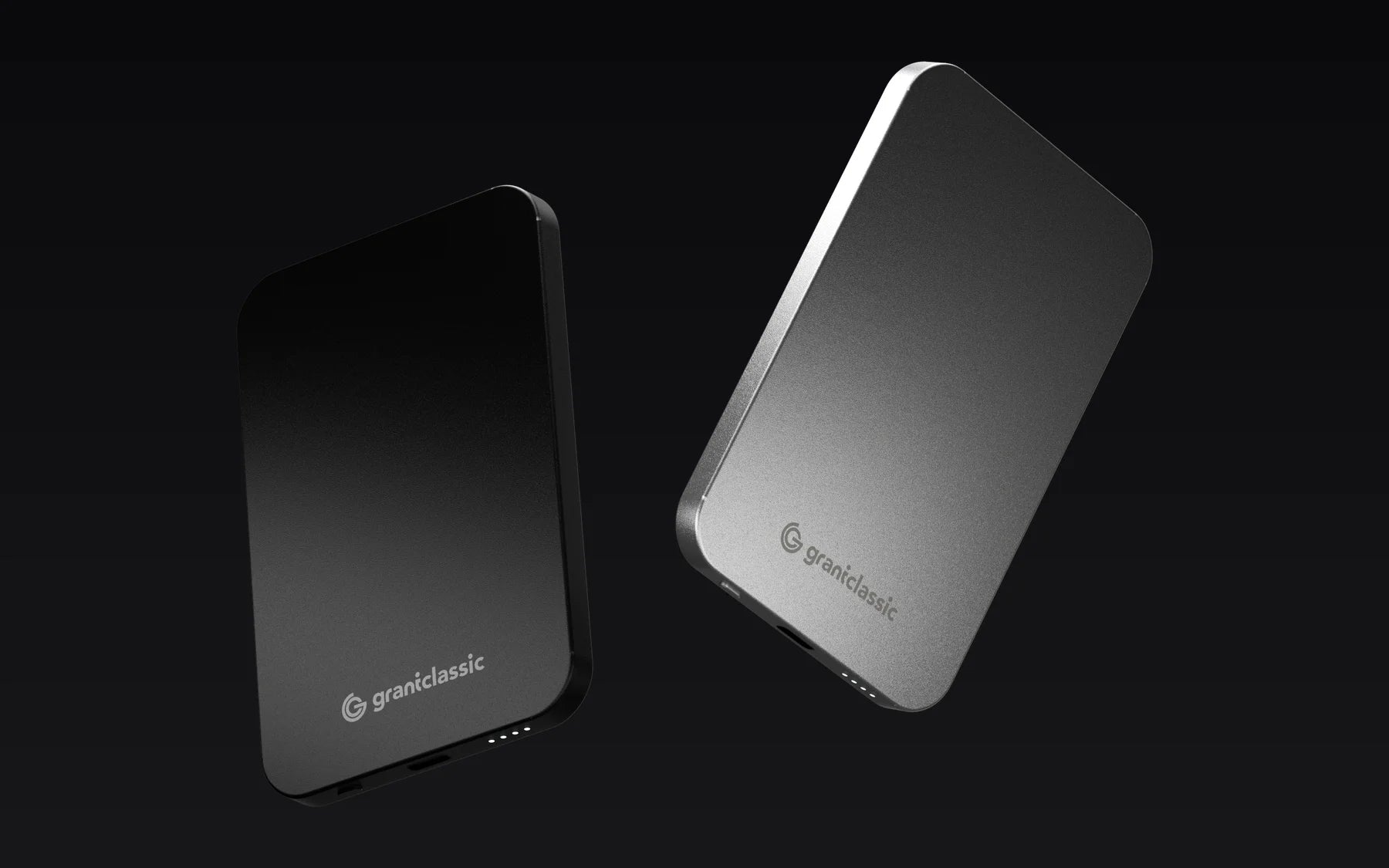
Graphite Black. Polar Silver.
Scroll to turn it all the way around. The MagSafe magnet ring, the seamless aluminum side, the 2.5D curved edge, the Type-C port. Every face, up close.
First in Asia. Now in the US.
Total raised across three campaigns for the seriesAbout $413,000
TITANSHIELD's first generation topped $300K crowdfunding on Zeczec in Taiwan; the Pro generation hit its funding goal in both Taiwan and Japan - safety translates across languages.


Find the TITANSHIELD that's right for you.
How to choose a power bank: all three use semi-solid-state cells and pass the same safety tests. Air is ultra-thin, TITANSHIELD is the everyday balance, Pro is flagship performance - pick the one you need.

TITANSHIELD Air
5000 mAh / 6 mm / 113 g
Thin enough to forget it's in your pocket.
69

TITANSHIELD
5000/10000 mAh / 15W / Watch charging
Five-in-one charging, one device instead of a tangle of cables.
From 69

TITANSHIELD Pro
10000 mAh / Qi2.2 25W / TFT display
Double the capacity, and it warns you before something goes wrong.
99
- Battery capacity
- 5,000 mAh
- 5,000 / 10,000 mAh
- 10,000 mAh
- Thickness
- 6 mm
- 11 / 19 mm
- 13 mm
- Weight
- 113 g
- 155 / 255 g
- 214 g
- Wireless output
- Magnetic 15W
- 15W
- Qi2.2 magnetic 25W
- Wired output
- 18W
- 20W
- 30W
- Apple Watch charging
- —
- ✓
- —
- Battery display
- —
- —
- TFT display
- Folding stand
- —
- —
- Hidden stand
- Safety alarm
- —
- —
- Yes
- Cell
- Semi-solid-state Li-ion
- Semi-solid-state Li-ion
- Semi-solid-state Li-ion
- Thermal protection
- NTC sensing, auto throttle
- NTC sensing, auto throttle
- NTC sensing, auto throttle
- Price
- 69
- From 69
- 99
TITANSHIELD Air
6 mm / 113 g / 5,000 mAh / 15W magnetic
69
All the numbers.
Every item from the manual, listed here exactly as written.
- Brand
- grantclassic
- Product name
- TITANSHIELD Air Magnetic Power Bank 5,000 mAh
- Model
- 2607-PM07
- Battery technology
- Semi-solid-state lithium-ion
- Battery capacity
- 5,000 mAh (3.85V / 19.25Wh)
- Rated capacity
- 2,800 mAh (5V / 14.0Wh)
- Wireless output
- Magnetic wireless, up to 15W
- Type-C wired
- Up to 18W (input / output)
- Simultaneous output
- Wireless and wired at the same time: each side gets half the power
- Magnetic hold
- 1.5 kg (N52 magnets, meets the MagSafe spec)
- Body
- CNC-machined aluminum unibody (220-grit bead blast + anodized)
- Panel
- 2.5D AG optical shatter-resistant glass
- Protection
- NTC temperature sensing. Output power drops automatically once the cell reaches 45°C
- Dimensions
- 103.3 × 69.0 × 6 mm
- Weight
- 113 g
- Price
- 69
- In the box
- Power bank, user manual, warranty card, Type-C cable
Safety testing
Nail penetration test at the SGS Taiwan reliability laboratory. Report HE50024/2026, June 10, 2026. Sample model 486578. Voltage 4.458 V before the test, 0 V after. Peak temperature 44.0 °C. Visual inspection found no fire and no explosion.
Thermal protection
A built-in NTC sensor lowers output power automatically once the cell reaches 45°C.
Warranty and service
1-year warranty. Register online and we add a second year, for two years total.
What people say.
FAQ
How does the warranty work?
Can I take it on a plane?
My phone has no MagSafe. Can I still use it?
Does the Air have the safety alarm?
How is the Air different from TITANSHIELD and the Pro?
How do returns work?
How is a solid-state power bank different from a regular one?
Why do power banks catch fire, and how do I avoid it?
Still doing your research?
Power bank safety, how to choose one, and solid-state technology, written from our own testing.
 Can a Power Bank Explode? Solid-State Nail Penetration Test and PSE Certification Explained
Are solid-state power banks really safer? A third-party nail penetration report, PSE and CCC certification data, and what the numbers do and do not prove.
Read the article ›
Can a Power Bank Explode? Solid-State Nail Penetration Test and PSE Certification Explained
Are solid-state power banks really safer? A third-party nail penetration report, PSE and CCC certification data, and what the numbers do and do not prove.
Read the article ›
 Is a Swollen Power Bank Still Safe to Use? Causes and What to Do
Can you keep charging a power bank whose case has bulged? No. Stop using it and stop charging it. Here are the common causes of swelling, the warning signs, the safe steps to take,...
Read the article ›
Is a Swollen Power Bank Still Safe to Use? Causes and What to Do
Can you keep charging a power bank whose case has bulged? No. Stop using it and stop charging it. Here are the common causes of swelling, the warning signs, the safe steps to take,...
Read the article ›
 How to Read Power Bank Certifications: Capacity Is Not the Point, the Safety Marks Are
How do you judge power bank certifications? This guide covers the BSMI inspection mark, capacity labeling, and cell chemistry, so you stop comparing mAh alone and pick a pack that is genuinely safe and...
Read the article ›
How to Read Power Bank Certifications: Capacity Is Not the Point, the Safety Marks Are
How do you judge power bank certifications? This guide covers the BSMI inspection mark, capacity labeling, and cell chemistry, so you stop comparing mAh alone and pick a pack that is genuinely safe and...
Read the article ›
 What Is Power Bank Thermal Runaway? The Battery Safety Facts Behind the Airplane Headlines
What is power bank thermal runaway? From cell structure and common causes to lowering the risk, explained in one place, along with how solid-state battery design works and how to pick a pack you...
Read the article ›
What Is Power Bank Thermal Runaway? The Battery Safety Facts Behind the Airplane Headlines
What is power bank thermal runaway? From cell structure and common causes to lowering the risk, explained in one place, along with how solid-state battery design works and how to pick a pack you...
Read the article ›
 Power Bank Recalls: How to Self-Check and When to Replace
Power bank recalls keep making the news. Is yours safe? Check the official recall list in 30 seconds, run three self-checks, and see how solid-state cells lower the risk at the source.
Read the article ›
Power Bank Recalls: How to Self-Check and When to Replace
Power bank recalls keep making the news. Is yours safe? Check the official recall list in 30 seconds, run three self-checks, and see how solid-state cells lower the risk at the source.
Read the article ›
It's got you covered.
What matters is covered. grantclassic is based in California, with a team spanning Taiwan and the US - from product concept and development to quality control and manufacturing, every product is built for daily use.