




When a power bank gets recalled, the useful response is not to forward the news, but to check the one in your bag. Power bank recalls have been in the headlines regularly in recent years, usually tied to defective battery materials, overheating, or a fire risk from swelling. Most coverage repeats the notice without telling you how to judge whether your own power bank is a problem. This article fills that gap, from self-checks and the recall process to the safety features worth looking for in a replacement.
What a power bank recall is usually about
Almost every recall notice comes down to the risk of thermal runaway. Conventional liquid lithium batteries can, under certain conditions such as overcharging, crushing, or an internal short, enter a chain reaction that produces heat, smoke, or fire. That is why a manufacturer starts a recall as soon as a particular production batch shows an unusually high failure rate. Common causes fall into a few groups: defective cell materials, quality control lapses in a production run, inadequate circuit protection, or cell aging that goes unnoticed after long use. For more on how thermal runaway works, see our earlier article, what thermal runaway is, and the battery safety facts behind the airline headlines.
Recall lists usually name the model, production batch, or serial number range, and it is on you to check whether yours is included. But what if your power bank is not on any list and it is already swelling or running hot? That part is rarely covered, so here it is.
A 30-second check: has your power bank been recalled?
Rather than waiting for the news to explain it, go to the official list. In Taiwan, power bank recalls are published on the product safety site run by Taiwan's Bureau of Standards, Metrology and Inspection (BSMI). The process is simple:
- Find the brand and model: check the label or engraving on the back of the unit, the packaging, or your original order record.
- Open the BSMI recall list: go to BSMI product recall notices (electronics category), where power bank recalls are collected.
- Match the manufacturer or brand name: the list is organized by the company issuing the notice. Open anything that looks like a match, and the notice will list the exact models, batches, or serial numbers.
- If yours is listed: stop using and charging it immediately, contact the company as described in the notice to arrange a return or exchange, and keep your proof of purchase.
- If it is not listed: do not relax yet. A recall list only covers the batches a manufacturer already knows about. The three self-checks below are more useful.
Recalls are not a rare event, either. In the past year alone, BSMI has published more than 10 power bank recall notices, including familiar brands. For which models and batches are currently listed, go by the latest notices on the BSMI recall page. Thirty seconds of checking beats any forwarded news story.
Why they get recalled: mostly factory defects, not user error
Many people assume a power bank fails because it was misused, but the official data points elsewhere. According to an August 2026 report by Taiwan's Public Television Service, BSMI recalled more than 310,000 power banks in the space of a year, and the leading cause of fires was factory defects: excess iron particles inside the cell, poorly welded contacts, or a battery management system (BMS) that failed to detect a temperature problem and cut power in time. In other words, the risk was built into those batches on the production line, and had little to do with how they were used.
The fire numbers are rising too. The same report cites Taipei City Fire Department figures showing 217 lithium battery fires in Taipei from 2019 to 2025, 56 of them, about a quarter, involving power banks. Between 2024 and 2025 alone, power bank fires went from 7 to 15, doubling in a year. The report also flags a structural risk in units with a built-in wall plug, where the weight of the whole battery rests on the prongs, which over time invites poor contact or a short.
One more thing that gets overlooked: a power bank is a consumable. Typical service life is about 2 to 3 years, or roughly 500 to 1,500 charge cycles. Even with no recall and no visible problem, an over-age cell carries more risk every year, and swelling, unusual heat, or a sharp drop in runtime means it is time to retire it (see is a swollen power bank still safe to use? causes and how to handle it).
Three self-checks: swelling, heat, and runtime
Knowing what to look for beats waiting for a notice. Here is the basic check we recommend:
- Swelling: look for bulges, widening seams in the casing, or a soft spot when you press on it. This usually means gas has formed inside the cell, and it is the clearest warning sign there is.
- Unusual heat: a warm casing during normal charging or discharging is reasonable. Heat that persists when nothing is plugged in and nothing is in use, or a noticeable jump in temperature while charging, is worth taking seriously.
- Runtime dropping sharply: with the same habits, a full charge lasting noticeably fewer days, or a large gap between the displayed charge and the real runtime, can signal cell aging or an internal fault.
If your power bank has already started to bulge, do not rush to charge it or toss it in a backpack. For how to assess and handle it properly, see is a swollen power bank still safe to use? causes and how to handle it.

Not on the recall list, but showing symptoms?
Stop using it first, then decide between service and disposal. This is the part almost nobody spells out. Most people assume that no recall means no risk, but a recall list only reflects the faulty batches a manufacturer has identified so far. If you see any of the symptoms above, stop charging and discharging, keep the unit out of hot places, and contact the manufacturer's support team about inspection or service. If they determine there is a safety risk, they will typically offer a replacement or refund, though turnaround varies by brand. Keep your proof of purchase and a written record of the problem so the case is easier to follow up.
Certification marks are your first filter when buying a new one
Before you buy, check the paperwork. For power banks sold in Taiwan, look for BSMI product inspection and NCC certification, and on some products SGS safety testing or CCC certification. These marks mean a third party or a regulator reviewed the product, rather than the manufacturer simply declaring it safe. For how to read the certifications and what people commonly miss, see how to read power bank certifications: capacity is not the point, the safety marks are.
Our TITANSHIELD line has passed SGS safety testing and holds Taiwan BSMI product inspection and NCC certification, along with CCC certification. The certificate numbers are printed on the unit or the packaging so you can verify them yourself.
Starting with the cell: how solid-state batteries lower the risk
Rather than waiting for a recall, start with a cell that is more thermally stable. The TITANSHIELD line uses a new generation of solid-state lithium cell technology, which compared with a conventional liquid lithium battery offers higher thermal stability and better puncture resistance. The design focuses on reducing the risk of thermal runaway, keeping the cell structurally stable even under extreme conditions so it does not burn or smoke. That does not mean a solid-state battery carries no risk at all. It means that at the material level, it is inherently less likely to reach thermal runaway than a conventional liquid cell.

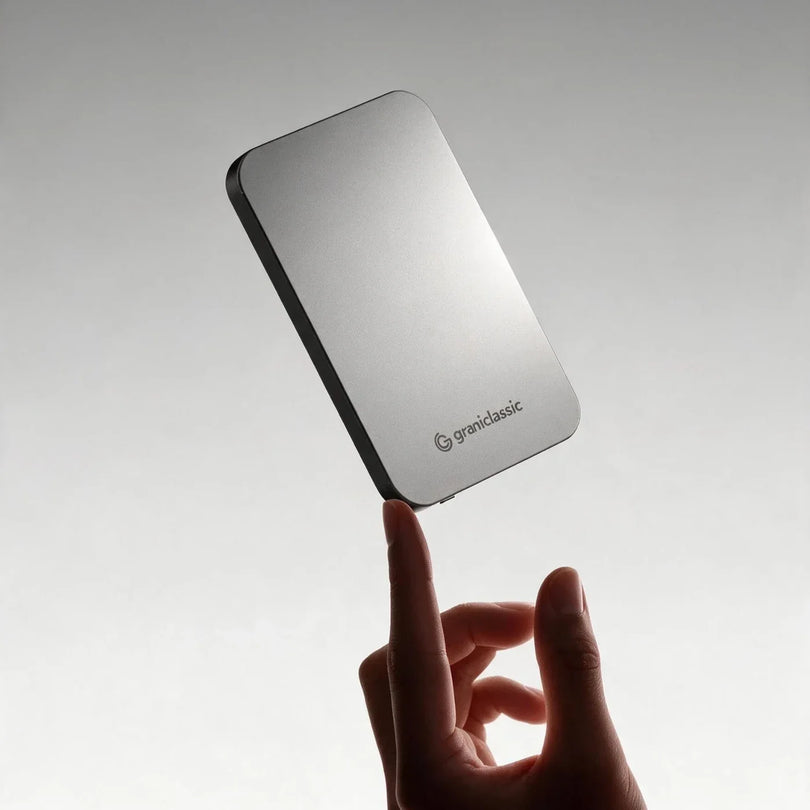
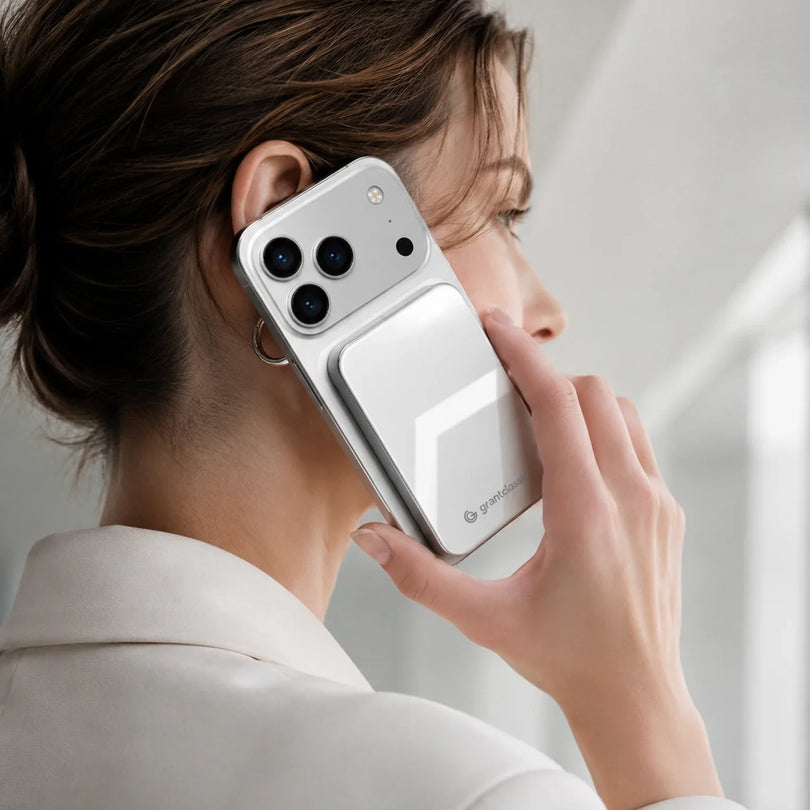
TITANSHIELD comes in two capacities: the 10,000 mAh Solid-State Power Bank at $79, for long days out or topping up several devices, and the 5,000 mAh Solid-State Power Bank at $69, smaller and lighter for a short commute. Both support MagSafe magnetic wireless charging and 20W USB-C PD wired fast charging, and both can charge one device wirelessly and another over the cable at the same time, such as a phone on the back and AirPods on the cable.

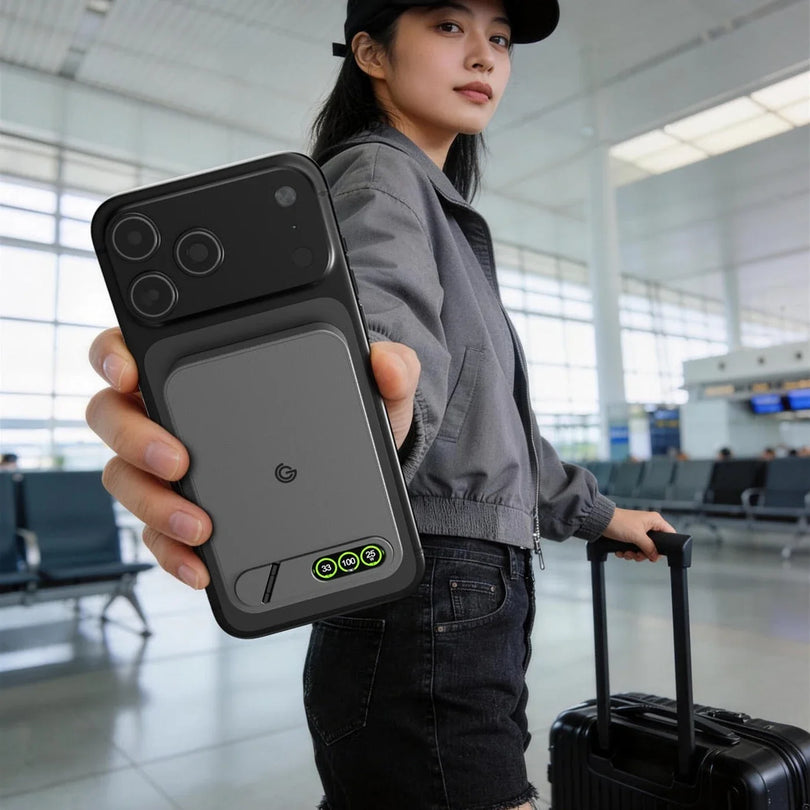
For a higher-spec model with faster wireless charging, look at the TITANSHIELD Pro Solid-State Power Bank. The Pro is also 10,000 mAh with the same solid-state lithium cell technology, but adds a TFT display that shows remaining charge and charging status in real time, so you are not guessing. It also has a built-in folding stand, handy for propping up a phone during a show or a video call. Wireless charging steps up to 25W (Qi2.2), noticeably faster than the standard model's 15W, which cuts the wait when charging a phone on the back. If you like having a charge readout, or you want faster wireless charging, the Pro suits you better than the standard model.

Flying with a power bank: read the watt-hour rating
Before you fly, check the Wh (watt-hour) rating rather than just the mAh. Most airlines draw the line at 100 Wh, above which you need approval or face quantity limits, and 160 Wh and up is generally banned from both checked and carry-on bags. A clear Wh figure on the unit or the packaging makes check-in and security much smoother. If yours lists only mAh, convert it yourself (Wh is roughly mAh x voltage / 1000) or ask the manufacturer. For fuller buying and storage advice, see can a power bank explode? a complete guide to buying, storing, and using one safely (2026).
FAQ
How do I check whether my power bank has been recalled?
Go to BSMI product recall notices (electronics category), match the manufacturer or brand name, and open the notice to check the model and production batch. If yours matches, stop using it and contact the company as the notice describes. If it does not, still check periodically for swelling, unusual heat, or a sharp drop in runtime.
How many years does a power bank last?
Generally about 2 to 3 years, or roughly 500 to 1,500 charge cycles. Even if it looks fine, an aging cell past that point carries more risk each year. If you see swelling, heat with nothing plugged in, or a clearly shorter runtime, replace it regardless of age.
What kind of power bank is TITANSHIELD?
TITANSHIELD is grantclassic's solid-state power bank line. It uses a new generation of solid-state lithium cells, which compared with conventional liquid lithium batteries offer better thermal stability and puncture resistance, lowering the risk of overheating, smoke, and fire. The idea is simple: power, not fire. It supports MagSafe magnetic wireless charging and 20W USB-C PD wired fast charging in a thin, portable body.
Which TITANSHIELD models are there, and what are the capacities and prices?
There are three: the standard 5,000 mAh at $69, the standard 10,000 mAh at $79, and the Pro 10,000 mAh, which adds a TFT display and a folding stand, at the price currently listed. The standard model comes in black and white. For a short commute, the 5,000 mAh is the pick. For long days out or topping up several devices, choose the 10,000 mAh or the Pro.
What safety certifications does TITANSHIELD have?
TITANSHIELD has passed SGS safety testing and holds Taiwan BSMI product inspection and NCC certification, along with CCC certification. The certificate numbers are printed on the unit or the packaging. The solid-state cell design itself is also built around reducing the risk of thermal runaway.
How can TITANSHIELD charge?
Both ways. For wireless charging, snap the phone magnetically to the back of the unit (15W on the standard model, 25W Qi2.2 on the Pro). For wired charging, use a USB-C cable with 20W USB-C PD fast charging. The USB-C port is bidirectional, so the same cable charges your phone or recharges the power bank itself.
Can it charge two devices at once?
Yes. TITANSHIELD can charge one device wirelessly on the magnetic back and another over USB-C at the same time, such as a phone on the back and AirPods on the cable.
 TITANSHIELD Pro 10000 mAh Solid-State Power BankSolid-state cell, 25W wireless fast chargin...
View product
TITANSHIELD Pro 10000 mAh Solid-State Power BankSolid-state cell, 25W wireless fast chargin...
View product


