





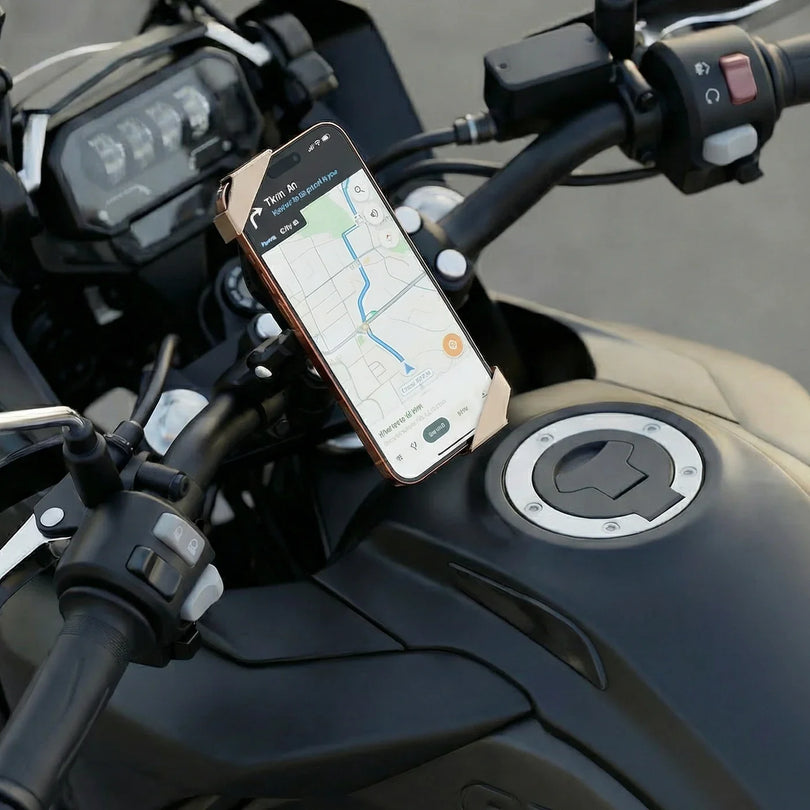


If your phone is clamped firmly to a motorcycle mount, is the camera safe? Not necessarily. A firm grip mainly keeps the phone from shifting or falling. If the vibration from riding still passes straight into the phone, over time it can affect the optical image stabilization and autofocus hardware inside some phone cameras.
Apple has warned that high-amplitude vibration in certain frequency ranges, particularly from large-displacement or high-power motorcycle engines, can degrade iPhone camera performance. Even on a scooter or an electric bike, where vibration is milder, Apple recommends a vibration-dampening mount if the phone will be attached for long periods, and advises against frequent, prolonged exposure to vibration.
So when you choose a motorcycle phone mount, the question is not only how tightly it grips, but whether it is designed to reduce how much vibration reaches the phone.

Why motorcycle vibration can affect a phone camera
Many mid-range and high-end phones now include optical image stabilization (OIS) or closed-loop autofocus, which keep images steady and sharp when your hands shake slightly, when light is low, or when you move while recording.
These features are not just software corrections. They rely on tiny mechanical movements of lenses, sensors, gyroscopes, and magnetic components.
Optical image stabilization (OIS)
When the phone detects hand shake, the lens or the image sensor shifts slightly in the opposite direction to cancel the blur. That mechanism was designed for the small movements of everyday handheld shooting, not for absorbing engine and road vibration hour after hour.
Closed-loop autofocus
Closed-loop autofocus uses sensors to track lens position continuously and correct focus quickly. Extended exposure to vibration at certain frequencies and amplitudes can add load to the camera module, which may show up as focus or stabilization problems.
According to Apple's support documentation, OIS and closed-loop autofocus are built to be durable, but long-term direct exposure to high-amplitude vibration at particular frequencies can still degrade camera performance and affect photo and video quality.
When to pay extra attention
Putting a phone on a motorcycle mount does not automatically mean damage. The real risk depends on the bike, the road, how long the phone is mounted, where it sits, and how the mount is built. These situations deserve extra care:
- Large-displacement bikes or bikes with noticeable vibration: engine vibration travels through the frame, the bars, and the mirror stems into the mount. Displacement is not the only thing that matters. The actual frequency, the amplitude, and the mounting position count just as much.
- Running navigation for hours every day: delivery work, long commutes, and touring can leave a phone mounted for hours at a stretch, which increases total exposure.
- Frequent potholes, construction, or rough pavement: beyond engine vibration, potholes and uneven surfaces add sharp impacts that make the phone and mount bounce noticeably.
- Rigid mounts with no cushioning at all: if there is almost nothing to absorb shock between the phone, the clamp, the arm, and the base, vibration reaches the phone more directly.
- A loose mount or an off-center load: a mount that is not fully tightened, a joint extended too far, or a phone whose weight sits off the mount's center all amplify shake while riding.
A tight grip is not the same as vibration damping
The first thing many riders do when picking a mount is give it a shake to see how firmly the phone is held. But holding and damping solve two different problems.
| What the structure does | Main purpose |
| Clamping and locking | Keeps the phone from shifting, loosening, or popping out |
| Cushioning and damping | Reduces how much engine and road vibration reaches the phone |
| A solid base | Keeps the whole mount from rotating, drooping, or working loose while riding |
A very strong grip with no cushioning material or damping structure keeps the phone from falling, but the phone still shakes along with the mount. The reverse is also true: soft cushioning without solid locking can let the phone shift over a pothole or under hard braking.
A well-designed mount covers all three at once, stable clamping, vibration damping, and a firm base, rather than simply squeezing the phone as hard as possible.
Signs your phone camera may have been affected
If your phone has spent long stretches on a motorcycle and you notice any of the following, stop mounting it on the bike and look into it further:
- The camera preview keeps shaking while the phone is held still.
- Photos often will not focus, or the focus hunts back and forth.
- Shots taken in normal light still come out clearly blurry.
- Video shows unnatural wobble or waviness.
- Image quality is obviously off after switching to a particular lens.
That said, a blurry image does not always mean a damaged camera module. It can also come from a dirty lens, interference from a case or magnetic accessory, a software glitch, or low light. Try cleaning the lens, removing accessories that might interfere, restarting the phone, and testing the front and rear cameras separately. If the problem persists, have the manufacturer or a qualified repair shop take a look. Apple camera troubleshooting guide
How to reduce the effect of motorcycle vibration on your camera
1. Use a mount with vibration damping built in
Beyond checking that the phone is held firmly, look for silicone or other cushioning material where the phone makes contact, and for a mount body designed to absorb some of the vibration.
Damping reduces how much vibration gets through. It does not block all of it, and it cannot guarantee that a phone camera will never fail.
2. Keep the phone centered in the mount
Once installed, the phone should sit as close to the center of the mount as possible, with even pressure all around, rather than resting on one side or a single contact point. If the case is too thick or too slick, or the camera module keeps the clamp from closing, switch to a more suitable case or reposition the phone.
3. Shorten the arm and tighten every joint
The longer the arm, the more leverage it creates while riding, which amplifies phone shake. Keep the arm as short as you can without hurting visibility or usability, and confirm that the base, ball head, knobs, and every connection are tight.
4. Avoid long, continuous exposure to heavy vibration
If your bike vibrates noticeably, or you have a long stretch of rough road ahead, switch to voice navigation and check the route after pulling over somewhere safe. On high-vibration bikes especially, do not treat a damping mount as a guarantee of full isolation.
5. Build a quick pre-ride check into your routine
Spend ten seconds before you set off confirming that the phone is fully locked in, the silicone has not hardened, no screws are loose, and the mount is not cracked or deformed. Check again after a big pothole, an impact, or a long ride.
Eight-point locking plus four-corner damping
If you commute, navigate, or ride long distances regularly, look for a mount that combines multi-point holding with a damping structure.
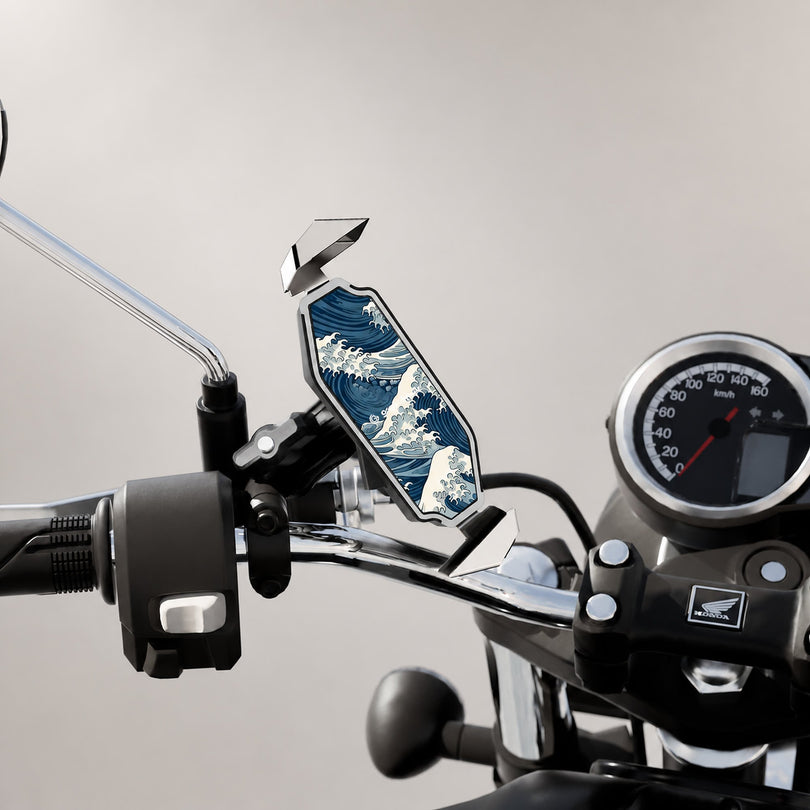
The OctaStand motorcycle phone mount, tracker bay edition uses an eight-point locking structure that holds the phone at several contact points, combined with four-corner damping and silicone cushioning, so it covers both stable clamping and vibration damping. A one-touch knob and quick-release design also cut the time spent mounting a phone every day.
The tracker bay edition takes a compatible tracker for your phone platform, so besides holding your phone while you ride, the mount gives you one more clue to where your bike is after you park. Note that tracking is an aid to finding it, not a replacement for a steering lock, a disc lock, or other physical security.
No motorcycle phone mount can eliminate vibration entirely. OctaStand's damping structure is meant to reduce some of the shake and vibration transmitted while riding, and real-world results still depend on the bike, the installation, the road, the weight of the phone, and how long it is mounted.

FAQ: motorcycle vibration and phone cameras
Does motorcycle vibration affect every phone?
Not necessarily. It depends on the camera hardware, the strength and frequency of the vibration, how the phone is mounted, and for how long. Phones with OIS or closed-loop autofocus contain precision moving parts inside the camera, so they are the ones to keep away from long, direct exposure to high-amplitude vibration.
Electric bikes have no engine vibration. Do they still need damping?
An electric bike does without the vibration of a combustion engine, but potholes, tires, suspension, and the chassis still produce vibration and sharp impacts, so a stable mount with cushioning is still recommended for long navigation sessions.
Can a damping mount fully protect the camera?
No. Damping reduces some of the transmitted vibration. It cannot remove every frequency and direction. If your bike vibrates heavily, shorten the time the phone stays mounted, or use voice navigation to cut the exposure.
My phone lens makes a noise. Does that mean stabilization is broken?
Not necessarily. On some phones with OIS, a light movement while the camera is closed produces a faint sound from the camera module, and sound alone is not a diagnosis. Look into it further if you also see focus failures, a preview that keeps shaking, or clearly blurry images. And do not shake the phone hard just to test it.
Not dropping the phone is the baseline. Cutting vibration is what matters long term
The basic job of a motorcycle phone mount is holding the phone steady while you ride. For riders who navigate constantly, commute long distances, or cover rough roads, grip strength alone is not enough.
A mount with multi-point holding, cushioning material, and a damping structure, installed correctly and checked regularly, lowers the risk of a dropped phone, a loose mount, and continuous vibration all at once. Damping is not an absolute guarantee. It is one more layer of protection that makes every commute and every navigation run a little steadier.
 OctaStand Motorcycle Phone MountEight-arm grip, tool-free install, steady t...
View product
OctaStand Motorcycle Phone MountEight-arm grip, tool-free install, steady t...
View product


