





Travel to a show and your phone works all day: tickets on the train, digital entry in the line outside, hours of filming and photos, then a rideshare and a hunt for your friends afterward. Plenty of people are doing all that on a phone that is a few years old with a battery that already fades, and on a day of continuous heavy use it is common to be down to 10% before the encore is over.
Bringing the wrong power bank spoils the day too. Too little capacity and you run out halfway. Too much and your shoulder pays for it. This article uses a stage-by-stage method to work out whether this show calls for 10,000 or 20,000 mAh, and covers weight, older phones and charging while you film, the three things concertgoers ask about most.
Before you look at capacity, break the day into stages

The most common mistake is shopping by the size of the mAh number alone. The better approach is to split the day into stages and estimate how much your phone drops in each:
- Getting there (2 to 3 hours on a train or bus): scrolling, music, streaming, roughly 20 to 30%.
- Waiting to get in (1 to 2 hours): pulling up the digital ticket, photographing merch, texting friends to find each other, 15 to 25%.
- The show itself (2 to 3 hours of filming and photos): this is the brutal stretch. Continuous recording, screen at full brightness, and a phone hunting for a tower in a crowded venue drain two to three times faster than usual, easily 40 to 60%.
- Getting home: rideshare, navigation, letting people know you are back, another 15 to 20%.
Add it up and a phone that is two or three years old often needs somewhere between one and one and a half times its own battery in extra power across the day. Put differently, you are not looking for one top-up. You are looking to charge as you go and hold out until the end.
10,000 or 20,000 mAh? It depends on the day

With the stage-by-stage picture in hand, capacity gets easy to decide:
Go with 10,000 mAh when: travel is short, you are staying nearby after the show, and your phone is relatively new (battery health still above 85%). A 10,000 mAh pack takes a typical phone from empty to full about one and a half to two times, which covers a single show and a same-day round trip. It is light and easy to slide into a bag.
Go with 20,000 mAh when: you are traveling across the state, taking a long train or bus ride, doing two nights in a row, or your phone has clearly aged and drains fast. A 20,000 mAh pack handles three to four full charges and leaves enough to rescue a friend's phone. The cost is weight, which the next section covers.
One point that gets overlooked: the capacity printed on a power bank is not the energy that reaches your phone. Between voltage conversion and cable losses, roughly 60 to 70% of the rating actually lands. A 20,000 mAh pack delivers something like 12,000 to 14,000 mAh into a phone. Apply that discount when you do the math and you will not overestimate.
Weight: the trade-off nobody mentions
General admission means standing for hours, and every extra 100 g (3.5 oz) in your bag registers. A typical 20,000 mAh lithium power bank runs 350 to 400 g (12 to 14 oz), and with cables, photocards and light sticks on top, your shoulder complains before the opener finishes.
That is a big part of why solid-state power banks come up so often among concertgoers now. Solid-state cells carry higher energy density, so the same capacity can be built thinner and lighter, which means less weight for the same runtime. If you want to understand how solid-state manages both capacity and lower weight, see our complete guide to solid-state power banks, which walks through cell structure and safety.
A practical compromise: carry a light 10,000 mAh pack for a same-day trip, and step up to 20,000 mAh for an overnight or back-to-back shows. Match the pack to the day instead of hauling the heaviest one every time.
An older phone drains fast, and a power bank is only half the fix
A phone that is a few years old and burns through its battery is a familiar situation. One thing worth being clear about: if the phone's own battery has degraded, a power bank tops it up but cannot stop it draining, and you may find that charging feels like filling a leaky bucket.
To judge whether a phone battery needs service or replacement, look at charge cycles and battery health. The same logic applies to the power bank itself, which also has a lifespan and loses capacity over time. Check both before a concert so you do not discover at the venue that the power bank has aged too.
Charging while you film: magnetic wireless is the quiet hero
The worst moment at a show is 5% left while you are filming the encore. A cable is awkward here: it tugs, your hand gets tied up, and holding the phone overhead gets harder.
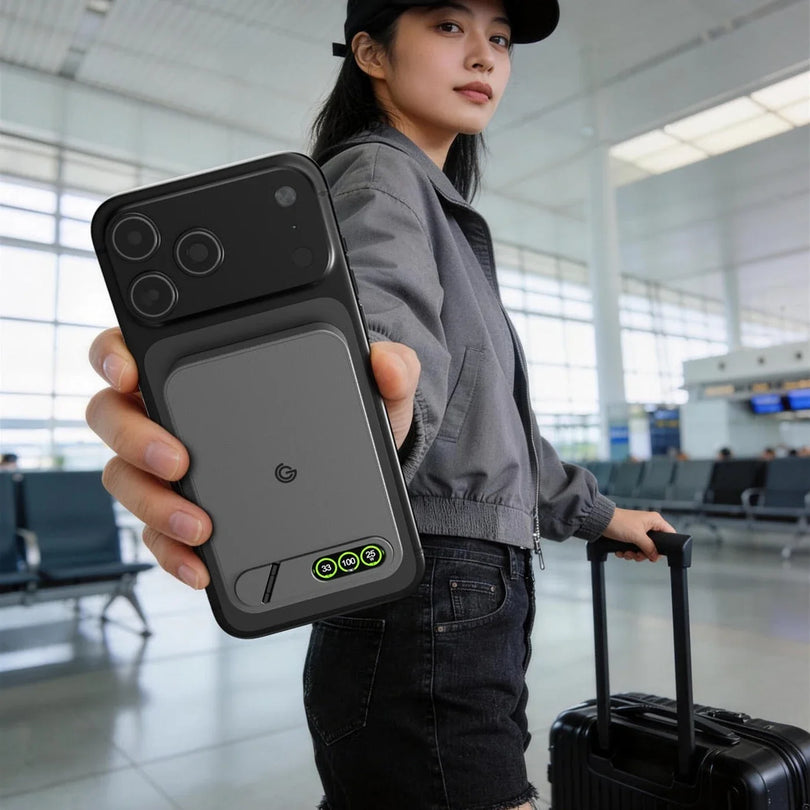
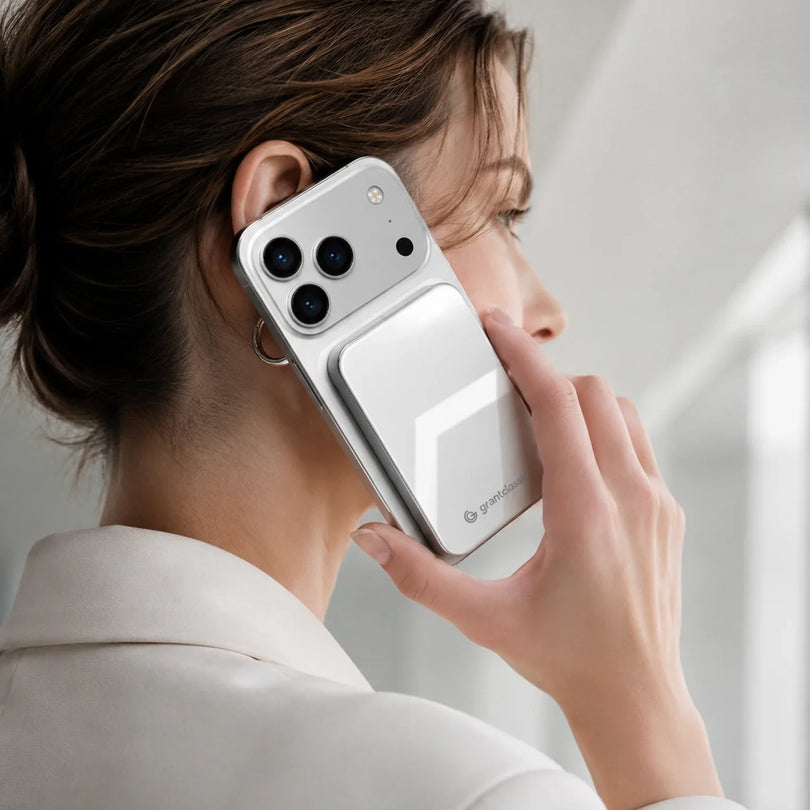
A magnetic wireless power bank (MagSafe or Qi2) shines in exactly this situation. It snaps onto the back of the phone, charges while you record, and leaves you filming one-handed with no cable to manage. When shopping, look for official WPC Qi2 or Qi2.2 certification, which means the magnetic hold has been tested and will not slide off mid-song, and the output power is verified too. For how to check Qi2.2 certification yourself and how it differs from plain Qi2, see the TITANSHIELD Pro Qi2.2 certification explainer.
Worth noting: wireless charging is slightly less efficient than wired and runs warmer, and heat matters more in a packed venue. Treat it as emergency runtime while you are filming, and use wired fast charging in the gaps before the show to fill up more efficiently.
Can you take it on the train or a plane?
Trains and buses have no special restrictions on power banks, so carry yours as normal.
Flying to a show is a different matter. A power bank goes in carry-on baggage only, never checked. Up to 100 Wh (roughly 27,000 mAh) needs no approval, 100 to 160 Wh requires airline approval, and anything above 160 Wh is not allowed. Confiscations at security are common enough that it is worth checking your airline's rules before you leave, rather than finding out at the gate.
Fast charging tricks for the line outside
The one to two hours in line is the ideal window to top up. Make it count:
- Use wired PD fast charging first: faster than wireless and cooler, it can put a phone back to 80% in that window.
- Close background apps before you film: navigation, streaming and Bluetooth headphones you are not using drain more than you would think.
- Lower screen brightness and turn on low power mode: a venue is dark, so the screen does not need full brightness, and it noticeably extends filming time.
- Do not wait until it is empty: lithium batteries are most efficient between 20 and 80%, so topping up at 30% treats the battery better than running to zero first.
FAQ
Is one 10,000 mAh pack enough for a concert?
For a same-day trip with a phone that is not too old, usually yes, since it covers about one and a half to two full charges. For long-distance travel, heavy filming throughout, or a phone that has clearly aged, 20,000 mAh is the safer call.
Why does filming drain a battery so fast?
Continuous recording keeps the camera running, the screen at full brightness, and the processor working hard to encode video, and a phone in a venue with poor signal raises transmit power hunting for a tower. Those three together can drain two to three times faster than normal.
Will a magnetic power bank fall off while I am filming?
A model with WPC Qi2 or Qi2.2 certification, with magnet strength that meets the standard, holds relatively securely. Certification means the magnetic hold and power output passed official testing, which is more reliable than a maker simply claiming magnetic support.
Wireless charging certification is not the only label that confuses people. Safety marks on the power bank itself do too. For how to check them and what to watch for, take a look at our guide to power bank certifications and how to choose, and get the safety side covered as well.
Does a big power bank fix an old phone?
A power bank adds energy, it does not stop the phone from draining. If the phone's battery has degraded badly, check its health and consider a replacement, otherwise charging works like adding water to a leaky bucket.
grantclassic. Build a classic experience.
 TITANSHIELD Pro 10000 mAh Solid-State Power BankSolid-state cell, 25W wireless fast chargin...
View product
TITANSHIELD Pro 10000 mAh Solid-State Power BankSolid-state cell, 25W wireless fast chargin...
View product


