




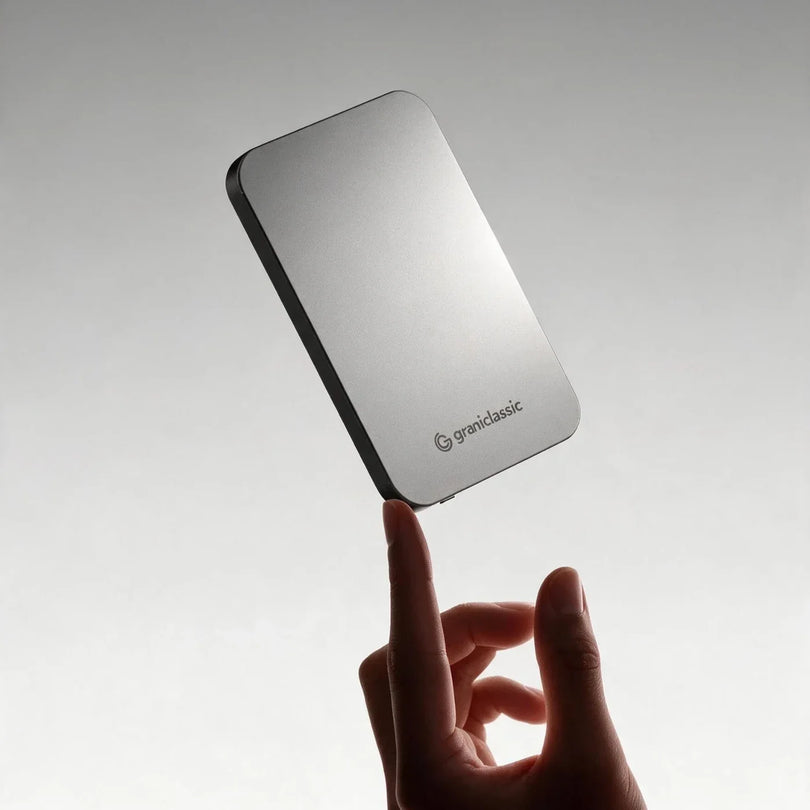





That power bank that has followed you through business trips and vacations for years: when did you last take a good look at it? Most people run them until something goes wrong, then notice the charge draining unusually fast, or the case feeling hotter than it used to, and realize the thing has a lifespan.
A power bank typically lasts 300 to 1,000 charge cycles, which works out to roughly 2 to 4 years of real use. Past that point, capacity drops noticeably. It does not just stop filling up your phone, it can also start to become a safety concern. This article covers what a charge cycle actually is, which habits retire a pack early, how to care for one properly, and the signals that say it is time to replace it.
Do power banks have a shelf life? How lifespan is calculated
Like every lithium battery product, a power bank has a built-in design limit that engineers call cycle life. Every charge and discharge moves lithium ions between the positive and negative electrodes, carrying a little chemical energy along and leaving behind a little irreversible chemical change.
There is a straightforward way to put a number on it: the rated lifespan is how many full charge and discharge cycles the cell can complete before its capacity falls below 80% of what it started with.
For a typical power bank, that number lands somewhere between 300 and 1,000 cycles, depending on cell quality, factory specification, and how you use it. If you run one down every day, you will usually see a clear capacity drop in about 1.5 to 3 years. If you only grab it for trips, four years or more is realistic. But lithium batteries age on their own even sitting in a drawer, losing roughly 2% to 5% of maximum capacity per year.
Which means the old pack you think of as barely used is probably smaller than you remember.

What is a charge cycle? How long does a lithium battery hold up?
Plenty of people assume a charge cycle means plugging in once. The definition is different.
One full charge cycle is 0% to 100% and back down to 0%. If you only ever top up half the battery, it takes two of those to add up to one cycle. Plugging in the charger is not the same as spending a cycle.
Based on the lithium-ion cells commonly used in power banks on the market, typical lifespans look like this:
| Cell quality | Cycle life | Real-world years (based on 2-3 uses per week) |
|---|---|---|
| Entry level (unbranded or budget cells) | About 300 cycles | 1.5 to 2 years |
| Standard consumer (brand-name cells such as Panasonic or Samsung) | 500 to 800 cycles | 2.5 to 4 years |
| Industrial / high-quality cells | 800 to 1,000 cycles | 4 to 5 years |
| Solid-state battery (such as TITANSHIELD) | 1,500 cycles and up | 7 years or more in theory |
Dropping below 80% of original capacity is the industry's general definition of end of life. That 10,000 mAh pack of yours may have less than 8,000 mAh of usable capacity left, and the decline speeds up from there rather than sliding down in a straight line.

Which habits retire a power bank early?
Take the same cell: good habits can carry it four years, bad ones can leave it useless in 18 months. Here are the five most common battery-aging behaviors. See how many you recognize:
1. Using it while it charges (treating it as a pass-through hub)
Charging the power bank while it also feeds your phone puts the cell through two chemical reactions at once and builds heat inside faster. Fine in a pinch, but not something to make routine.
2. Leaving it fully charged for long stretches
Sitting above 95% is a slow injury to a lithium battery. At high voltage, the cathode material oxidizes gradually, which costs capacity you do not get back. For everyday storage, 40% to 60% is best. Fill it up right before you head out.
3. Waiting until it is completely dead to charge
Deep discharge, below about 5%, is one of the harder things you can do to a lithium battery. At very low charge, lithium tends to plate onto the anode as dendrites that do not go away, shortening life over time and, in bad cases, causing an internal short.
4. Storing it somewhere hot
A car interior, a pocket in direct sun, a desk by a window: in summer, any of those can pass 50°C (122°F) easily. The best storage range for lithium batteries is 15°C to 25°C (59°F to 77°F). Heat speeds up electrolyte breakdown, and every 10°C (18°F) increase roughly doubles the rate of chemical aging.
5. Charging with an unstable charger or a poor cable
Unsteady current and noisy voltage deliver a small shock to the cell every time you charge. Picking a charger is not only about wattage. Regulation quality matters just as much, which is why choosing the right charger helps protect cell life.
How do you care for a power bank so it lasts longer?
Battery care is not complicated. A few habits cover most of it:
The golden rule: stay between 20% and 80%
This is the advice battery engineers get quoted on most often. Do not run it to empty, and do not routinely fill it to the top. For everyday carry, top it up around 30% and stop around 80%.
Before long storage: bring it down to 50% first
Traveling for a month without it? Discharge to about 50% before putting it away. Storing it full speeds up cathode oxidation, and storing it empty risks over-discharge.
Where to keep it: cool, dry, out of direct sun
The ideal storage temperature is 15°C to 25°C (59°F to 77°F) at 45% to 75% relative humidity. A dedicated spot in a drawer is far safer than the car.
Run one full cycle a month
At least once a month, take the pack from 20% up to 100% and back down to 20%. That helps recalibrate the battery management system (BMS) so the charge readout stays accurate.
Avoid charging and discharging at the same time
Fine when you are in a hurry, but do not leave the pack plugged in and working inside a bag, wrapped in fabric, for long stretches.
A practical maintenance schedule, from unboxing to retirement
| Time since purchase | Recommended action |
|---|---|
| Month 1 | Run 2 to 3 full charge and discharge cycles (0 to 100 to 0) so the battery management system (BMS) completes its initial calibration |
| Every month | Run one full cycle as maintenance, and keep it between 20% and 80% day to day |
| Every 6 months | Clean the charging ports (a dry toothbrush works) and check cable connectors for corrosion or looseness |
| Every year | Note how many times the same phone can go from 20% to full, and compare against when the pack was new to gauge capacity loss |
| Year 2 | Full visual inspection: any swelling, any unusual heat from the case, and whether replacement is worth considering |
| Years 3 to 4 | Actively plan a replacement, and stop using the pack immediately if any warning sign appears |
Which warning signs mean it is time for a new power bank?
Some signals take no technical background to read:
One more thing worth remembering: when you shop for a new power bank, do not judge by the capacity number alone. Safety certification marks are just as useful an indicator of cell quality.
Stop using it immediately
- The case is swelling or bulging: a sign the lithium cell is producing gas, which means something has gone chemically wrong inside. Stop using it, do not try to puncture it, do not keep charging it, and dispose of it through battery recycling.
- Unusual heat: clearly hot to the touch while charging or discharging, roughly above 40°C (104°F), is not normal.
- A strange, sharp, sour smell: the smell of organic electrolyte evaporating, which means the cell is damaged and leaking.
Time to consider replacing it
- A clear drop in capacity: it used to charge your phone three times and now manages two, which means capacity is down by more than 30%.
- Charging has slowed noticeably: same charger, but a pack that used to fill in 2 hours now takes 4. That is a classic symptom of rising internal resistance.
- Indicator lights flashing oddly, or no response when plugged in: the BMS protection circuit may have failed, leaving it unable to measure charge accurately or protect the cell.
- More than 3 years old with any of the above: no reason to wait for it to fail outright. Safety first.
- Charge drains right after filling up: the cell has lost much of its ability to hold a charge, so a full readout may represent half the real energy.
About the BMS (battery management system)
Every power bank contains a BMS board that monitors voltage, current, and temperature, and cuts the circuit to protect the cell when something looks wrong. Those indicator lights you see are showing an estimate the BMS calculates from cell voltage, not a direct measurement of capacity. As the battery ages, the voltage curve changes and the estimate drifts, which is why an old power bank so often looks like it has three bars left and then dies.
A visual check every 2 years is a good habit, and at 3 to 4 years it is worth seriously evaluating a replacement.
How does a solid-state power bank compare on lifespan?
The reason conventional lithium batteries have a hard ceiling comes down to the liquid electrolyte. Every charge and discharge moves lithium ions through that liquid, and a layer called the SEI film (solid electrolyte interphase) gradually builds on the electrode surface. The thicker it grows, the more it limits how efficiently ions can move. Liquid electrolyte also oxidizes and breaks down under high voltage, and heat accelerates the process. That is the chemistry behind a conventional lithium battery getting worse the more you use it.
A solid-state battery replaces the liquid electrolyte with a solid material (ceramic, polymer, or sulfide), which changes two things:
- Solid electrolyte is chemically more stable, so it resists oxidation and breakdown during charge and discharge, and the SEI film problem shrinks considerably
- The solid structure suppresses lithium dendrite growth, which lowers the risk of an internal short and extends cycle durability at the same time
According to solid-state battery research (BSL Battery, 2025), solid-state cells can handle 1,500 to 2,000 charge cycles or more. Against the 300 to 1,000 cycles of a conventional lithium battery, that is a 2x to 5x advantage. Translated into calendar time, it moves the picture from a pack retired at 3 years to one that could last 7 years or more in theory.
TITANSHIELD Solid-State Power Bank uses a solid-state cell design. Beyond being more stable than conventional lithium under heat, its long-term lifespan is a dimension worth weighing when you pick a power bank. If you want to go deeper on how solid-state and conventional cells differ structurally, see our breakdown of cell structure.
FAQ
Can I leave a power bank plugged in all the time?
Not recommended. Most products have protection circuits, but leaving a full pack connected to power keeps it at a high state of charge, which accelerates cell aging. Unplug it when it is full and plug it back in when you need it.
My power bank sat unused for a long time. Is it still good?
Usually yes, though capacity has probably dropped. Lithium batteries age even when idle, losing about 2% to 5% of maximum capacity per year. After more than 2 years in storage, charge it and test how it actually performs. If the case shows any swelling, stop using it.
Can I take a power bank on a plane? Is there a capacity limit?
Yes, but only in carry-on baggage, never in checked luggage. US rules follow the same thresholds airlines use worldwide: up to 100 Wh needs no approval, 100 Wh to 160 Wh needs airline approval, and anything above 160 Wh is generally not allowed. New ICAO rules for 2026 update the tiers, and our full guide to flying with a power bank covers the details.
How do I recycle a dead power bank?
Not in household trash. In the US, take it to a battery or electronics drop-off point. Many electronics and hardware retailers host collection bins, and your city or county household hazardous waste program will accept them. Handle a swollen battery with extra care and do not compress it.
How can I tell whether capacity has shrunk?
The simplest method is to keep a record: with the same phone, how many times can the pack take it from 20% to 100%? Compare against when it was new. Fewer refills means capacity has dropped. Some higher-end power banks have an app that reports actual output, which is more direct.
Why do solid-state power banks cost more?
Solid electrolyte material costs more than liquid, and the manufacturing process demands tighter precision, so prices run higher today. Looked at another way: 2x to 5x the lifespan is roughly what you would spend on two or three conventional power banks, so over the long run it is not necessarily more expensive.
Most people are reactive about batteries and only replace one after it fails. Here is something to do now instead: dig out your power bank, check the case for swelling, and work out roughly how long you have had it. If it is past 3 years or anything looks off, that is your cue to start shopping.
Want a pack that lasts and does not risk thermal runaway? See how to choose a solid-state power bank.
If you have decided to replace yours, our 2026 power bank buying guide walks through capacity, safety, and use case in one pass.
 TITANSHIELD Pro 10000 mAh Solid-State Power BankSolid-state cell, 25W wireless fast chargin...
View product
TITANSHIELD Pro 10000 mAh Solid-State Power BankSolid-state cell, 25W wireless fast chargin...
View product


