




How to Choose a Solid-State Power Bank: Safety Basics and Capacity Guide
That power bank that has been in your bag for three years is starting to run hot, and the corners look a little puffy. Would you still leave it in a car sitting in the sun? That worry is exactly why solid-state power banks took off over the last two years. In short, a solid-state power bank replaces the liquid electrolyte in a conventional cell with a solid (or semi-solid) one. Solid electrolyte is not flammable and holds up better to heat, so the risk of thermal runaway and fire is far lower than with a standard liquid lithium cell. This article is not another "top ten picks" list. It explains what solid state actually changes, whether you want 5,000 or 10,000 mAh, how to read certifications and wireless charging specs, and how TITANSHIELD is built.
Want the model comparison first? Jump to the capacity section below and the certification table further down.
One honest note up front: almost every power bank sold as "solid state" is technically semi-solid-state, not the all-solid-state battery you read about in lab papers. That is not a loophole. It is the most practical option available right now, and here is why.
Why solid state is harder to set on fire
To understand the safety gain, start with what goes wrong in a normal liquid lithium cell.
A conventional lithium battery contains a flammable liquid organic electrolyte. If the cell is struck, overcharged, or left hot for long periods, it can enter thermal runaway: the temperature climbs fast, the liquid electrolyte begins to vaporize, and a spark from an internal short can ignite it. Lithium can also form branch-like crystals during charge and discharge (the industry calls them lithium dendrites) that pierce the separator and cause an internal short. That is a second path to a fire.
Solid and semi-solid cells differ in three ways:
- Solid electrolyte does not burn. Swapping the flammable liquid for a solid material removes the fuel from the equation, so a damaged cell is much less likely to ignite.
- Better thermal stability. Solid electrolyte tolerates a wider temperature range instead of degrading and vaporizing when it gets hot.
- The solid interface resists dendrites. A solid structure is harder for lithium dendrites to grow through, which lowers the chance of an internal short.
This is not marketing, it is basic electrochemistry: less flammable liquid plus more structural stability equals more margin. Drop the same pack on the floor, or leave it in the same hot car, and a semi-solid design has more room for error than a purely liquid one.
One caveat: "safer" is not "indestructible." Every lithium battery has a service life and physical limits. Any pack that swells, runs hot, or has a cracked shell should be retired immediately. A solid-state power bank raises your everyday safety margin. It is not permission to drop it or soak it.
Semi-solid, all-solid, liquid: what is actually on the shelf
These three terms get mixed up constantly. One table sorts them out:
| Type | Electrolyte | Safety | Availability today |
|---|---|---|---|
| Liquid lithium | Fully liquid organic electrolyte | Typical, depends on protection circuits and the separator | The mainstream in power banks, mature technology |
| Semi-solid-state | Solid-liquid hybrid or gel semi-solid | Higher than liquid, far less flammable liquid | What "solid-state power bank" actually means today |
| All-solid-state | Fully solid electrolyte | Highest in theory | Hard to mass-produce, still rare in consumer products, most automakers have pushed timelines past 2030 |
The takeaway: every "solid-state power bank" you can buy and carry today is essentially semi-solid. All-solid-state cells have higher energy density and longer cycle life, and the industry agrees they are the next step, but making them cheap, mass-produced, and small enough to fit in a pocket is not there yet.
So rather than chasing the phrase "all-solid-state," remember two things. First, semi-solid already delivers a real safety improvement and is the practical choice right now. Second, a product that calls itself all-solid-state and sells unusually cheap deserves extra scrutiny. A brand that labels semi-solid honestly is generally more trustworthy than one that stays vague.
Is "solid-state power bank" just marketing?
Search that phrase and the first page of results is full of forum threads and videos asking whether any of it is real. Those questions deserve a straight answer, one at a time.
Objection one: "There is no such thing as an all-solid-state battery yet." Correct. As of 2026, all-solid-state batteries are still in labs and pilot lines. No mass-produced power bank anywhere uses a true all-solid-state cell, and as long as there is any liquid component inside, the strict term is semi-solid. Every solid-state power bank on the market, TITANSHIELD included, is semi-solid. We put that in writing, because what is worth comparing is never the word, it is the documentation you can verify.
Objection two: "Influencer tests are paid, they just puncture a dead cell on camera." Video can be staged, so rank your evidence: video is a supporting detail, third-party written reports are the main course. A report carries the test conditions, the date, the pass criteria, and a number you can ask the brand to produce for cross-checking. Editing cannot touch that. Third-party testing for the TITANSHIELD range (the 5,000, 10,000 and Pro use the same cell) is below:
| Test | Report number | Result |
|---|---|---|
| SGS nail penetration | HE50024/2026 | Peak surface temperature 44.0°C (111°F) after steel-pin penetration, no fire, no explosion |
| SGS overcharge | HE40037/2026 | Peak 32.0°C (90°F), no fire, no explosion |
| SGS over-discharge | HE40037/2026 | Peak 58.4°C (137°F), no fire, no explosion |
| SGS external short circuit | HE40037/2026 | Peak 23.4°C (74°F), the cell tab fused on its own and cut the short |
| SGS thermal abuse | HE40037/2026 | 60 minutes at 130°C (266°F), no fire, no explosion |
| Chemitox nail penetration (Japan) | No.251692 | 3 mm (0.12 in) steel nail driven fully through, no smoke, no rupture, no fire |
Objection three: "Solid state is a scam to charge more." Semi-solid is not magic. It solves a specific problem: it turns "what happens when this cell fails" from a coin flip into something with test data behind it. Whether that is worth a few extra dollars depends on where the pack lives, a front pocket, a hot car in August, plugged in on the nightstand overnight. If that is your daily reality, safety testing is not a marketing line, it is part of the spec.
5,000 or 10,000 mAh?
First, clear up a common misread: a 10,000 mAh label does not mean your phone receives 10,000 mAh. The cell is rated at 3.7 V and has to be boosted to 5 V to feed a phone, and that conversion loses energy. Usable output typically lands at 70% to 80% of the printed figure, so do not divide the label by your phone's battery capacity.
With that in mind, match capacity to how you actually move:
- 5,000 mAh: the thinnest and lightest, roughly one full iPhone charge plus a little. Right for a short commute or a "top me up before I run out" backup that disappears in a bag or a jacket pocket.
- 10,000 mAh: the sweet spot for size and weight, roughly two to three phone charges. Best if you are out all day, taking a half-day trip, or keeping a phone and earbuds alive at once.
- 20,000 mAh and up: four to six charges, but noticeably heavier. Suited to long trips, camping, or charging several devices at once. Carrying it on a daily commute gets old fast.
The short version: 5,000 for commuter backup, 10,000 for a full day out, 20,000 only for travel and multiple devices. For most people's daily routine, 10,000 mAh is the choice you are least likely to regret.
If you want the lightest option with the solid-state safety margin, look at the 5,000 mAh model that disappears in a shirt pocket. If you want one pack to cover a whole day without counting percentages, the 10,000 mAh version that refills a phone two or three times fits better.


Certification, wireless charging, and flying: three things to check
Once capacity is settled, these three details are easy to skip and directly affect safety and everyday usability.
How to read certification marks
Power banks sold in Taiwan must pass BSMI inspection, run by the Bureau of Standards, Metrology and Inspection. That testing covers overcharge, over-discharge, short circuit, and thermal protection. Wherever you shop, the basic check is the same: look for a real certification mark and a traceable inspection number on the product or the box, and skip any unbranded cell with no marking at all, no matter how cheap. TITANSHIELD Pro carries BSMI number R3I037 and NCC type approval CCAP26LP2001T4, both of which can be looked up in the Taiwanese public databases.
CCC certification: a second national approval
BSMI covers Taiwan and PSE covers Japan. CCC, China Compulsory Certification, is the mandatory gate for power banks entering the Chinese market under the GB 31241-2022 safety standard. CCC is not an optional sticker, it sits at the same level as BSMI and PSE. Both TITANSHIELD 5,000 mAh and 10,000 mAh hold Japanese PSE (certificate numbers WTF25X10284942 and WTF25X10284943, to JIS C 62133-2: 2020) and Chinese CCC (5,000 mAh certificate 2025100914641049, valid to 2030), and meet the BSMI requirements for sale in Taiwan. In other words, the safety design has been signed off in more than one market.
Third-party penetration testing: safety with numbers attached
Beyond certification, the clearest read on cell safety is a nail penetration test. TITANSHIELD commissioned an independent test at the Chemitox Hokuto LiB test center in Japan (report No.251692, dated 2025-11-07): a 3 mm (0.12 in) steel nail driven completely through the cell. Both the 5,000 mAh and 10,000 mAh produced no smoke, no rupture, and no fire, and the 5,000 mAh barely rose in temperature. To be clear about what that means: nail penetration is an abuse test, not a required item under PSE or BSMI, and it was run on top of the mandatory certifications. It shows how the solid-state cell behaves under defined physical damage. A thicker nail or a harder impact could behave differently, and it does not mean nothing can ever go wrong. When you shop, a brand that can hand you a verifiable report number is more trustworthy than one that only prints a safety adjective. The same cell also passed five SGS safety tests (penetration, overcharge, over-discharge, external short circuit, thermal abuse, reports HE50024/2026 and HE40037/2026); the numbers are in the table above.
What Qi2.2 wireless charging means
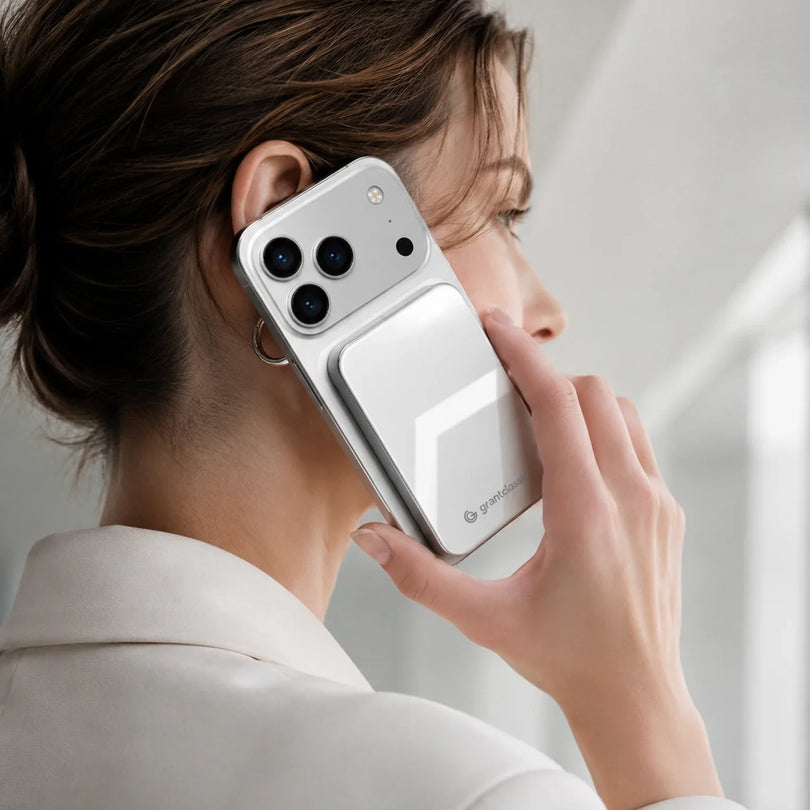
Wireless charging follows the Qi standard, and the version matters. Qi2 raises wireless fast charging to 25 W, well above the older 5 to 15 W, and it builds in magnetic alignment (compatible with Apple MagSafe) so the phone snaps to the back and lines up with the coil by itself instead of being nudged around. For iPhone 12 and later, or any Android phone with magnetic alignment, that is the difference between "set it down and it charges" and "hope it charges." Note that wireless charging is always slightly less efficient than wired, so when you are in a hurry a USB-C cable running PD is still fastest.

Can you fly with a power bank?
Yes, and watt-hours (Wh) decide the rules. Under the FAA and TSA rules that apply to US flights, a power bank under 100 Wh may be carried on with no approval needed; 100 to 160 Wh requires airline approval; anything over 160 Wh is not allowed. The math is Wh = mAh x voltage (3.7 V) / 1000, so 10,000 mAh works out to roughly 37 Wh, comfortably under the 100 Wh line. Everyday capacities clear security without a problem. Lithium batteries must travel in carry-on baggage only, never in checked bags, and it is worth confirming your airline's current policy before you fly.
FAQ
Are solid-state power banks really safer?
Yes, and it helps to know why. The gain comes from replacing a flammable liquid electrolyte with a non-flammable solid or semi-solid one and improving thermal stability, which lowers the risk of thermal runaway compared with a purely liquid lithium cell. It raises your everyday margin. It does not mean the battery will never fail, so any pack that swells, runs hot, or has a cracked shell should be retired right away.
Is a store-bought "solid-state power bank" all-solid-state?
Almost always it is semi-solid, not all-solid-state. All-solid-state batteries are hard to mass-produce and still rare in consumer products. Semi-solid already delivers a clear safety improvement and is the practical option today. If a product claims all-solid-state at an unusually low price, dig deeper before buying.
How do I choose between 5,000 and 10,000 mAh?
Match it to how you use it. Short commutes and simple emergency backup point to 5,000 mAh, which is thin and easy to carry. A full day out, a half-day trip, or charging several devices points to 10,000 mAh, good for two to three phone charges. Remember that boost conversion losses mean usable output is roughly 70% to 80% of the label.
How fast is 25 W Qi2.2 wireless charging?
25 W is the current Qi2 ceiling for wireless fast charging, a clear step up from the older 5 to 15 W, and the magnetic design (MagSafe compatible) aligns the phone with the coil the moment you set it down. In practice wireless still loses a little efficiency, so a USB-C cable running PD is faster when you are in a hurry. Wireless wins on convenience.
Why does a 10,000 mAh pack not deliver 10,000 mAh?
Because the cell is rated at 3.7 V and has to be boosted to 5 V to charge a phone, and that conversion loses energy. Usable output is typically 70% to 80% of the printed capacity. This is physics that applies to every power bank, not a cut corner. Factor the discount in and the numbers stop looking wrong.
How do I confirm a power bank is certified?
Look for a certification mark and inspection number printed on the product or the packaging. BSMI certification, the baseline for legal sale in Taiwan, covers overcharge, over-discharge, short circuit, and thermal protection tests. Skip anything with no marking at all. TITANSHIELD holds Japanese PSE (certificates WTF25X10284942 and WTF25X10284943) and Chinese CCC (5,000 mAh certificate 2025100914641049), meets the Taiwanese BSMI requirements, and has a Chemitox third-party penetration report (No.251692). Every one of those numbers can be checked.
Pick the one you trust, not the one that is cheapest
A power bank rides against your phone, in your bag, in the car, every day. The safety margin is worth a little thought. Walk the same path this article did: confirm it is an honestly labeled solid or semi-solid design, pick 5,000 or 10,000 mAh based on your day, then check the certification marks and the wireless charging spec.
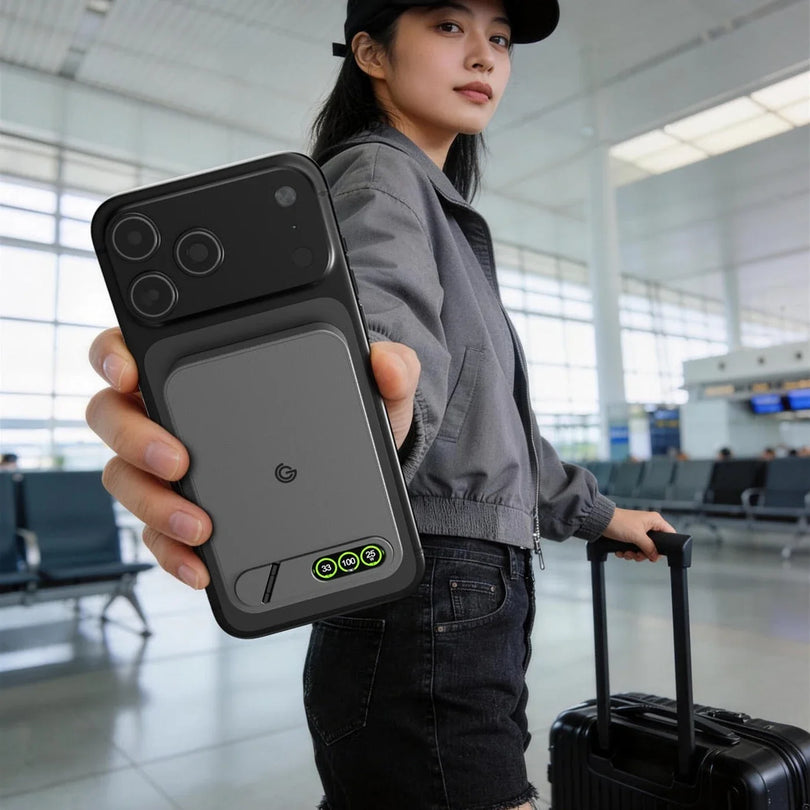
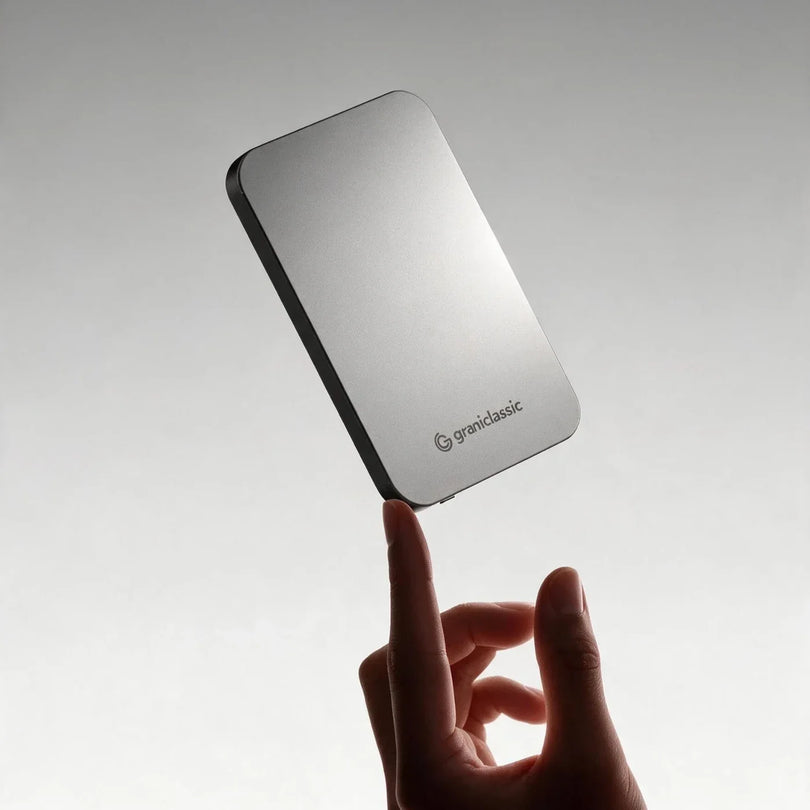
The grantclassic TITANSHIELD solid-state power bank was built on exactly that logic: a solid-state design that will not catch fire, swell or leak the way a failing liquid cell can, Qi2.2 25 W wireless charging, materials and certifications stated plainly, and every stage developed and tested in-house. The goal was a battery you can leave in a hot car without thinking about it. To see every capacity and finish in one place, browse the full TITANSHIELD solid-state power bank collection.

If you are still deciding how to shop for a conventional power bank, start with the five-step guide to buying a power bank, then come back and weigh the solid-state advantages.
Building a classic experience starts with a battery you never have to worry about.
 TITANSHIELD Pro 10000 mAh Solid-State Power BankSolid-state cell, 25W wireless fast chargin...
View product
TITANSHIELD Pro 10000 mAh Solid-State Power BankSolid-state cell, 25W wireless fast chargin...
View product


