




You have probably seen "supports Qi2" printed on power bank packaging. You rarely see a manufacturer produce an actual WPC certificate, signed, with a number you can look up. The gap between those two things is wider than it looks.
TITANSHIELD Pro received Qi2.2 certification from the Wireless Power Consortium (WPC) in June 2026. QI-ID: 27410, certified 2026-06-16, signed by WPC executive director Paul Struhsaker. Wireless output is 25 W Qi2.2 and wired output is 30 W USB-C PD, and the two can run at the same time. This is not a brand claiming to "support Qi2.2." It is a certificate issued after WPC's official test program, verifiable in a public database.
This article covers three things: how Qi2.2 differs from Qi2, how to check a WPC certificate, and what the certification means for your day-to-day wireless charging.

How Qi2 and Qi2.2 differ
WPC released Qi2 in 2023, opening Apple's MagSafe magnetic alignment technology as a public standard and setting 15 W as the baseline wireless charging power. That gave Qi2 Android phones and iPhones the same magnetic alignment and charging speed, instead of leaving it as an Apple-only feature.
Qi2.2 is WPC's update on top of Qi2, with improvements in a few directions:
Extended Power Profile: Qi2.2 introduces an optional higher-power transfer profile, allowing certain device classes to reach 25 W when safety conditions are met, which meaningfully improves charging efficiency for larger devices.
Stricter interoperability testing: Qi2.2 certification adds more device-combination interoperability checks, so that when Qi2.2 devices from different brands are paired, power output and magnetic alignment behave more consistently.
Improved thermal management standards: the updated specification puts finer requirements on temperature control during charging, which tightens the rules around heat build-up in long wireless charging sessions.
For a user, the most direct meaning is this: a Qi2.2 certified product has passed a more complete interoperability test than Qi2 required, so its charging behavior with a Qi2.2 phone is more predictable.
How to verify a WPC certificate yourself
"Supports Qi2" and "holds Qi2 certification" are different claims. Supports means the manufacturer says it is compatible. Certified means it passed WPC's official testing and has a verifiable certificate number.
Here is how to verify the TITANSHIELD Pro certificate:
Method one: open the certificate page directly
Go to https://jpsapi.wirelesspowerconsortium.com/products/qi/27410 to see the full certificate: product name, brand (grantclassic), part number (2601-PA16), certification date and signatory.
Method two: search the official WPC product database
Use the certified product search on the WPC site (wirelesspowerconsortium.com) and enter the brand name "grantclassic" or the QI-ID "27410."
The check takes about 30 seconds, and it tells you whether a power bank genuinely meets the WPC standard rather than carrying a self-applied "Qi2 compatible" label.
Wireless charging is not the only place certification marks get confusing. We have a separate guide to reading power bank safety certifications, covering the common marks and how to verify each one.

Where Pro sits, and why it is called Pro
The standard TITANSHIELD line (5,000 and 10,000 mAh) focuses on solid-state cell safety and capacity, and already holds three mandatory safety certifications, PSE (Japan), BSMI (Taiwan) and CCC (China), plus a nail penetration test report from Chemitox in Japan (No. 251692).
Pro adds official WPC Qi2.2 certification on top of that, making it a power bank that carries all of the following:
| Certification / spec | Type | Scope |
|---|---|---|
| WPC Qi2.2 (QI-ID 27410) | Wireless charging standard certification | MagSafe / Qi2 compatible devices |
| PSE (WTF25X10284942/943) | Mandatory safety certification for the Japanese market | Cell safety |
| CCC (2025100914641049) | Mandatory safety certification for the Chinese market | Cell safety |
| BSMI | Mandatory certification in Taiwan | Cell safety |
| Chemitox nail penetration test No. 251692 | Third-party test report | 3 mm nail penetration with no fire |
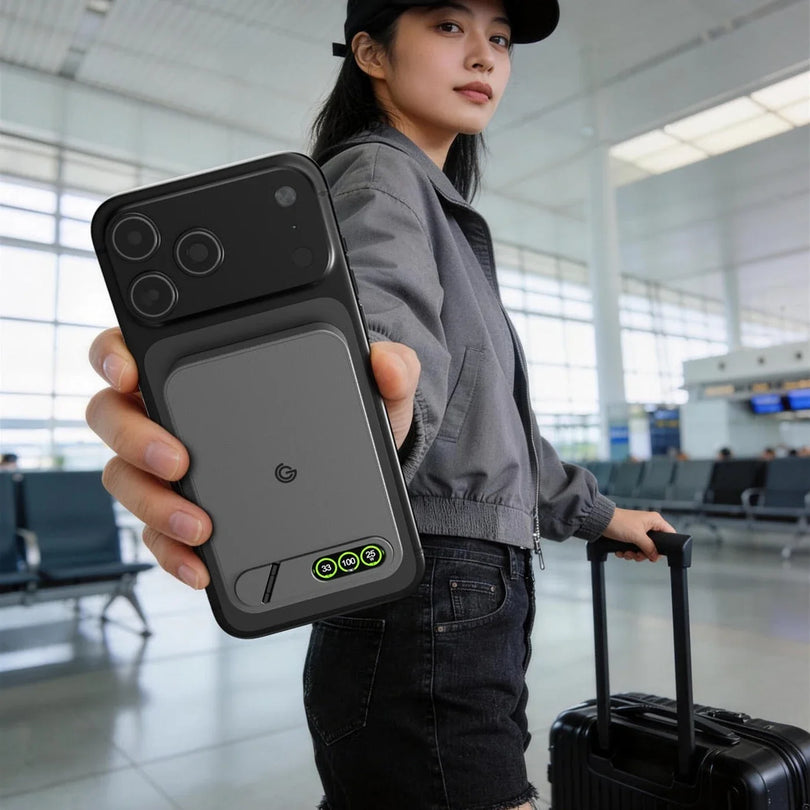
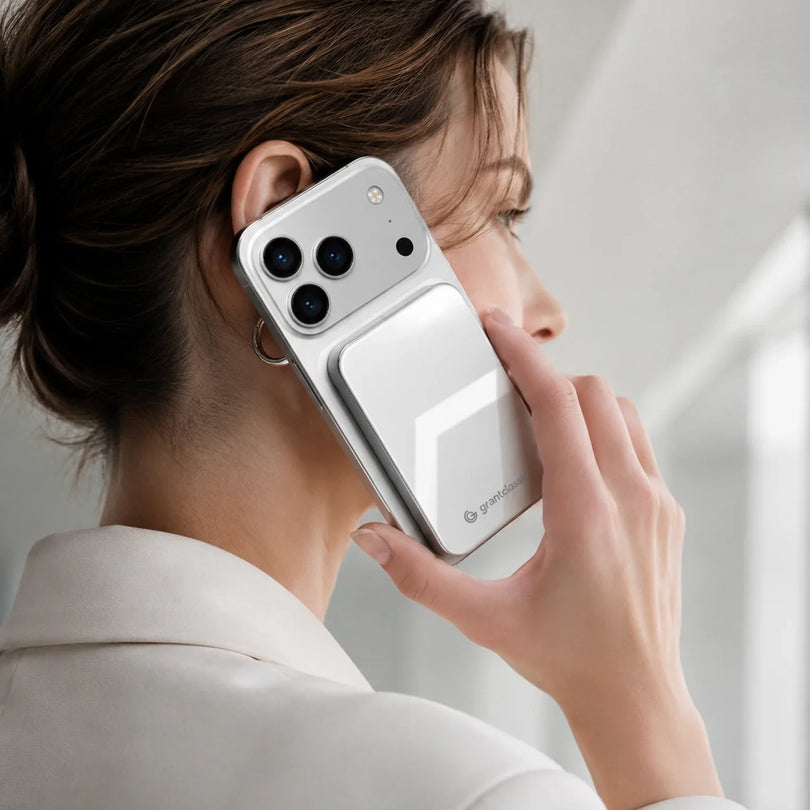
Pro is aimed at people who charge wirelessly every day: no cable to unplug, no fiddling for the right spot, set it down and the magnets do the rest. That works on a commute, at a desk, on a hotel nightstand. Pro's Qi2.2 certification is how you know the 25 W wireless output was verified against an official standard rather than asserted by the manufacturer.
When to choose Pro, and when the standard model is enough
Choose Pro if:
- Your phone supports Qi2 or MagSafe (iPhone 12 and later, Google Pixel 8 and later, Samsung Galaxy S24 and later)
- You habitually stick your phone on the pack magnetically and would rather not plug in
- You are willing to pay a little more for magnetic alignment that will not slide, plus simultaneous 25 W wireless and 30 W wired output
The standard 5,000 or 10,000 mAh is enough if:
- You charge mainly over USB-C and only occasionally go wireless
- Your phone has no MagSafe magnets, or is not a Qi2 compatible model
- Budget matters and solid-state cell safety is more important to you than Qi2.2 features
Both share the same solid-state cell safety specification: the nail penetration test, PSE, CCC and BSMI all apply to both. The difference is in how you use them. Pro adds one more layer, an official WPC guarantee on the wireless side.
FAQ
Does Qi2.2 charge faster than regular Qi2?
On most phones available today, the difference is hard to feel. TITANSHIELD Pro's wireless output is 25 W, which meets the Qi2.2 standard. To use the full 25 W, the phone has to support Qi2.2 as well, and supported models are still rolling out. If your phone is an iPhone 16 series or a 2026-or-later flagship Android, that is where the full Qi2.2 performance shows up.
Can I charge a phone without Qi2 wirelessly on TITANSHIELD Pro?
Yes. Qi2.2 is backward compatible with the Qi standard. A phone without Qi2 magnets will still charge wirelessly, at basic Qi speeds (5 to 10 W). Magnetic attachment will not work, since the phone has no matching magnets, but charging itself is unaffected.
Why does WPC certification matter more to me than a "supports Qi2" claim?
Certification means the product passed independent third-party interoperability testing, so when you set your phone down, the power, the magnetic force and the charging behavior all fall inside the specification. A self-declared compatible product carries no such assurance: you might get 7.5 W instead of 25 W, or magnets too weak to keep charging from cutting out. Checking the QI-ID is the most direct way to confirm.
Where can I look up the TITANSHIELD Pro Qi2.2 certification?
QI-ID 27410. The full certificate is at https://jpsapi.wirelesspowerconsortium.com/products/qi/27410.
Hands-on video
Tested by content creator iamIRONPA: drop and impact safety checks plus a Qi2.2 25 W wireless fast charging run.
Further reading
- How to choose a solid-state power bank: how it avoids thermal runaway, and picking a capacity
- What is a Qi2 power bank? Speed, compatibility and what to look for
- Wound vs. stacked cells in solid-state power banks, explained
grantclassic. Built for a classic experience.
 TITANSHIELD Pro 10000 mAh Solid-State Power BankSolid-state cell, 25W wireless fast chargin...
View product
TITANSHIELD Pro 10000 mAh Solid-State Power BankSolid-state cell, 25W wireless fast chargin...
View product


